
SUSTech team reveals mechanism by which ethylene receptors sense redox state of endoplasmic reticulum
DATE:2026-04-28
The endoplasmic reticulum (ER) is an important organelle in eukaryotic cells responsible for protein folding, lipid synthesis, and calcium homeostasis regulation. The redox balance inside its lumen is crucial for protein maturation and cellular homeostasis. ER redox imbalance can trigger ER stress and has been shown in animal systems to be closely associated with various diseases, but its physiological functions and sensing mechanisms in plants remain to be further elucidated. Ethylene, as an important hormone regulating plant growth, development, and stress response, has its signal perception and transduction occur at the ER, suggesting that there may be a deep connection between ER homeostasis and ethylene signaling.
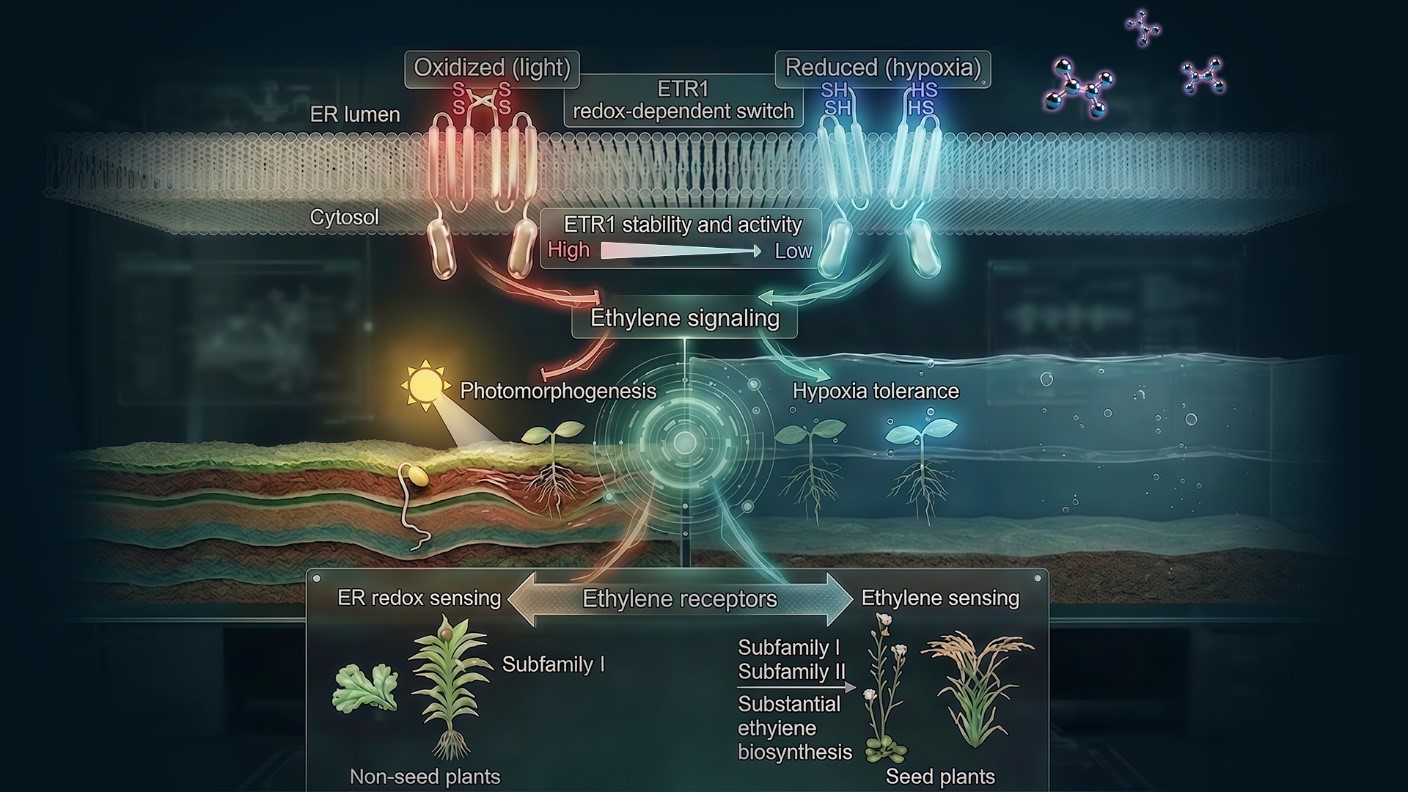
Recently, the team led by Hongwei GUO at the Southern University of Science and Technology (SUSTech) published a research paper in Cell titled “Sensing endoplasmic reticulum redox state by ethylene receptors,” revealing the mechanism by which plant hormone ethylene receptors sense the redox state of the ER. This study establishes a direct molecular bridge between organelle homeostasis and hormone signaling, providing a new perspective for understanding plant stress adaptation.
Key breakthrough: Ethylene receptors directly sense changes in ER redox state
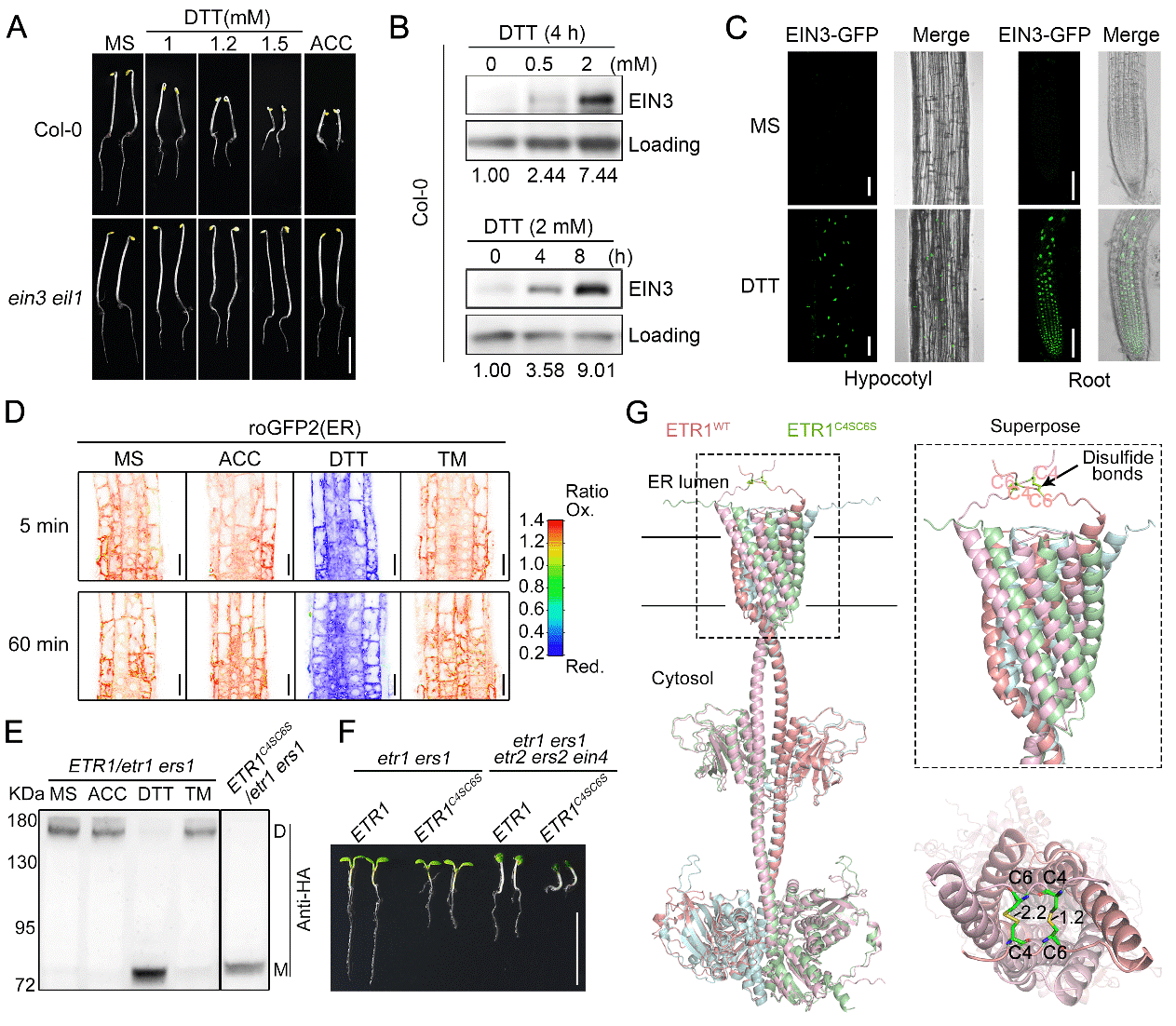
The research team discovered that the ER reductive stress inducer DTT can significantly activate ethylene signaling in a manner independent of the classical ER stress signaling pathway. Further studies showed that ethylene receptors can sense the redox state within the lumen through intermolecular disulfide bonds located in the ER lumen, which are crucial for maintaining the functional conformation of the receptor. Under reductive conditions, these disulfide bonds are broken, leading to decreased conformational stability of the receptor ETR1, accompanied by enhanced degradation and weakened interaction with the downstream core signaling component EIN2, thereby activating EIN3/EIL1-mediated ethylene responses. The study further revealed that in the presence of other ethylene receptors, the existence or absence of these two pairs of disulfide bonds does not affect receptor binding to ethylene but determines the receptor’s ability to sense the redox state. These results suggest that ethylene binding and ER redox sensing by the receptors may be two relatively independent processes that together determine the strength of downstream signal responses.
Adaptation Mechanism: Environmental Signals Finely Regulate Ethylene Response Through Endoplasmic Reticulum Redox State
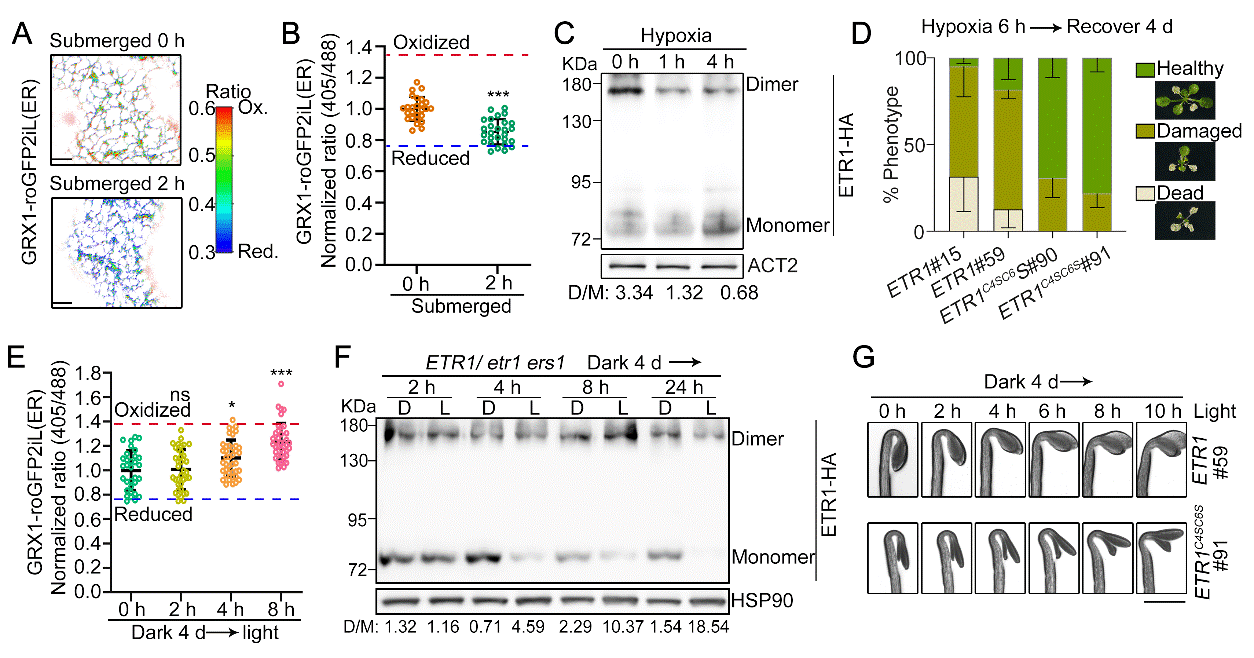
Further studies have found that changes in the natural environment can regulate ethylene signaling by affecting the redox state of the endoplasmic reticulum (ER). For example, under hypoxic conditions, the ER tends to be in a reduced state, and the disulfide bonds of ETR1 are broken, rapidly activating the ethylene response, which helps plants cope with low-oxygen stress. Conversely, during the transition of etiolated seedlings from dark to light, the ER’s oxidative state is enhanced, facilitating the formation of receptor disulfide bonds, thereby partially inhibiting ethylene signaling and promoting photomorphogenesis. This process constitutes a regulatory chain:
“environmental change—alteration of ER redox state—modulation of receptor structure and activity—change in ethylene response,”
Indicating that the ER redox state plays an important role in linking environmental signals with hormone responses.
Evolutionary Perspective: Functional Evolution from “Redox Sensors” to “Ethylene Receptors”
The research team noted that cysteine residues mediating disulfide bond formation are highly conserved across all terrestrial plants, from early mosses to angiosperms, and that these receptors generally have the ability to respond to redox states through intermolecular disulfide bonds. Disulfide bonds have a more significant impact on the function of ethylene receptors from non-seed plants. Due to the lack of the key enzyme ACO for ethylene synthesis in non-seed plants, both endogenous ethylene levels and sensitivity are relatively low, suggesting that sensing the redox state of the endoplasmic reticulum may be an older function of ethylene receptors, predating the biosynthesis of large amounts of ethylene. Based on this, the research team proposed that in early terrestrial plants, ethylene receptors may have primarily been involved in redox state sensing; as seed plants evolved new receptor subfamilies, through synergistic action between different receptors, they gradually acquired fine-tuned sensitivity to ethylene molecules while retaining the redox response capability. This evolutionary feature may provide a potential molecular basis for ethylene’s involvement in regulating seed plant-specific biological processes, such as seed development, flowering, and fruit ripening.
In summary, this study breaks the conventional understanding of the function of ethylene receptors: they are not only “receivers” of hormonal signals but also “environmental sentinels” of cellular endoplasmic reticulum (ER) homeostasis. Through the dynamic and reversible changes of disulfide bonds, ethylene receptors directly couple the redox state of the ER with downstream ethylene responses, enabling adaptation to environmental challenges such as hypoxia and light-dark transitions. The revelation of this “organelle homeostasis-hormone signaling” cooperative regulatory mechanism provides a new theoretical framework for understanding the multi-layered regulation of plant adaptability.
Research Assistant Professor Dongdong HAO from the School of Life Sciences at SUSTech is the first author of the paper, and Chair Professor Hongwei GUO is the corresponding author. SUSTech is the first and corresponding institution of the paper. The research team of Professor Hongwei GUO at SUSTech, including Zhina XIAO, Dr. Wei YAN, Dr. Chenliang PAN, Dr. Lian JIN, Dr. Yang PENG, Dr. Yuping QIU, and Dr. Xing WEN, jointly participated in the study. Researcher Kai HUANG and PhD student Yanting YANG from Shenzhen Bay Laboratory, Professor Wen SONG from China Agricultural University, Researcher Haodong CHEN and PhD student Zhiren CHEN from Tsinghua University, Professor Shi XIAO and PhD student Ying XING from Sun Yat-sen University, and Researcher Kai JIANG from Yunnan University also made important contributions to this study.
latest news
-
SUSTech Teams Uncover New Mechanism of Mitochondrial Autophagy Membrane Origin
Date:2026-08-11
-
SUSTech’s Tao DONG selected for American Society for Microbiology’s Mechanism Discovery Scientific Advisory Council
Date:2026-05-14
-
SUSTech team reveals mechanism by which ethylene receptors sense redox state of endoplasmic reticulum
Date:2026-04-28
-
SUSTech team identifies transposable elements as key determinants of 3D genome structure
Date:2026-03-16