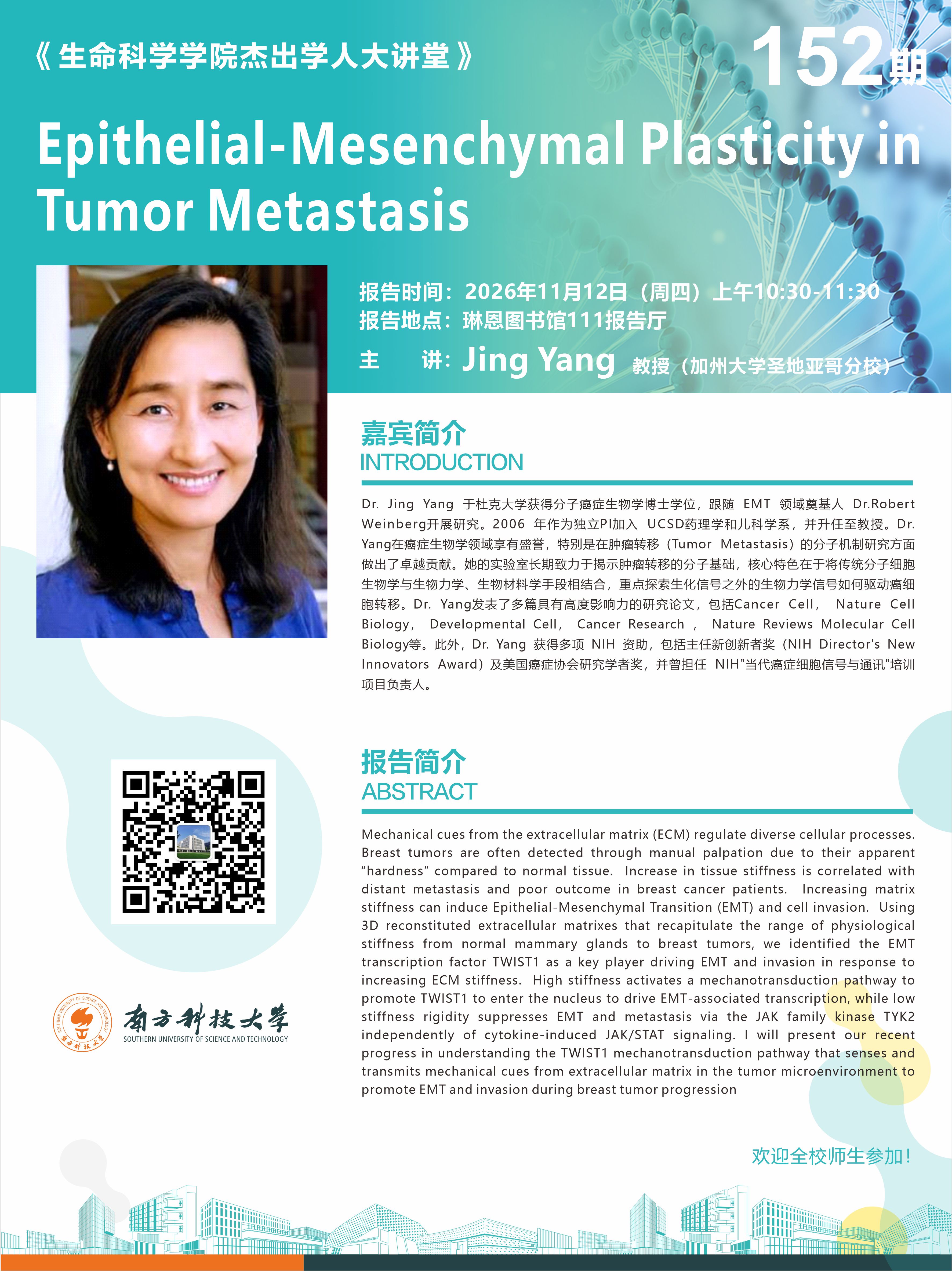
主讲人: Jing Yang 教授
时间: 2026年11月12日10:30-11:30
地点: 琳恩图书馆111报告厅
题 目:Epithelial-Mesenchymal Plasticity in Tumor Metastasis
主 讲:Jing Yang 教授
时 间:2026年11月12日(周四)上午10:30-11:30
地 点:琳恩图书馆111报告厅
报告摘要:
Mechanical cues from the extracellular matrix (ECM) regulate diverse cellular processes. Breast tumors are often detected through manual palpation due to their apparent “hardness” compared to normal tissue. Increase in tissue stiffness is correlated with distant metastasis and poor outcome in breast cancer patients. Increasing matrix stiffness can induce Epithelial-Mesenchymal Transition (EMT) and cell invasion. Using 3D reconstituted extracellular matrixes that recapitulate the range of physiological stiffness from normal mammary glands to breast tumors, we identified the EMT transcription factor TWIST1 as a key player driving EMT and invasion in response to increasing ECM stiffness. High stiffness activates a mechanotransduction pathway to promote TWIST1 to enter the nucleus to drive EMT-associated transcription, while low stiffness rigidity suppresses EMT and metastasis via the JAK family kinase TYK2 independently of cytokine-induced JAK/STAT signaling. I will present our recent progress in understanding the TWIST1 mechanotransduction pathway that senses and transmits mechanical cues from extracellular matrix in the tumor microenvironment to promote EMT and invasion during breast tumor progression
嘉宾简介:
Dr. Jing Yang 于杜克大学获得分子癌症生物学博士学位,跟随 EMT 领域奠基人 Dr.Robert Weinberg开展研究。2006 年作为独立PI加入 UCSD药理学和儿科学系,并升任至教授。Dr. Yang在癌症生物学领域享有盛誉,特别是在肿瘤转移(Tumor Metastasis)的分子机制研究方面做出了卓越贡献。她的实验室长期致力于揭示肿瘤转移的分子基础,核心特色在于将传统分子细胞生物学与生物力学、生物材料学手段相结合,重点探索生化信号之外的生物力学信号如何驱动癌细胞转移。Dr. Yang发表了多篇具有高度影响力的研究论文,包括Cancer Cell, Nature Cell Biology, Developmental Cell, Cancer Research , Nature Reviews Molecular Cell Biology等。此外,Dr. Yang 获得多项 NIH 资助,包括主任新创新者奖(NIH Director's New Innovators Award)及美国癌症协会研究学者奖,并曾担任 NIH"当代癌症细胞信号与通讯"培训项目负责人。