
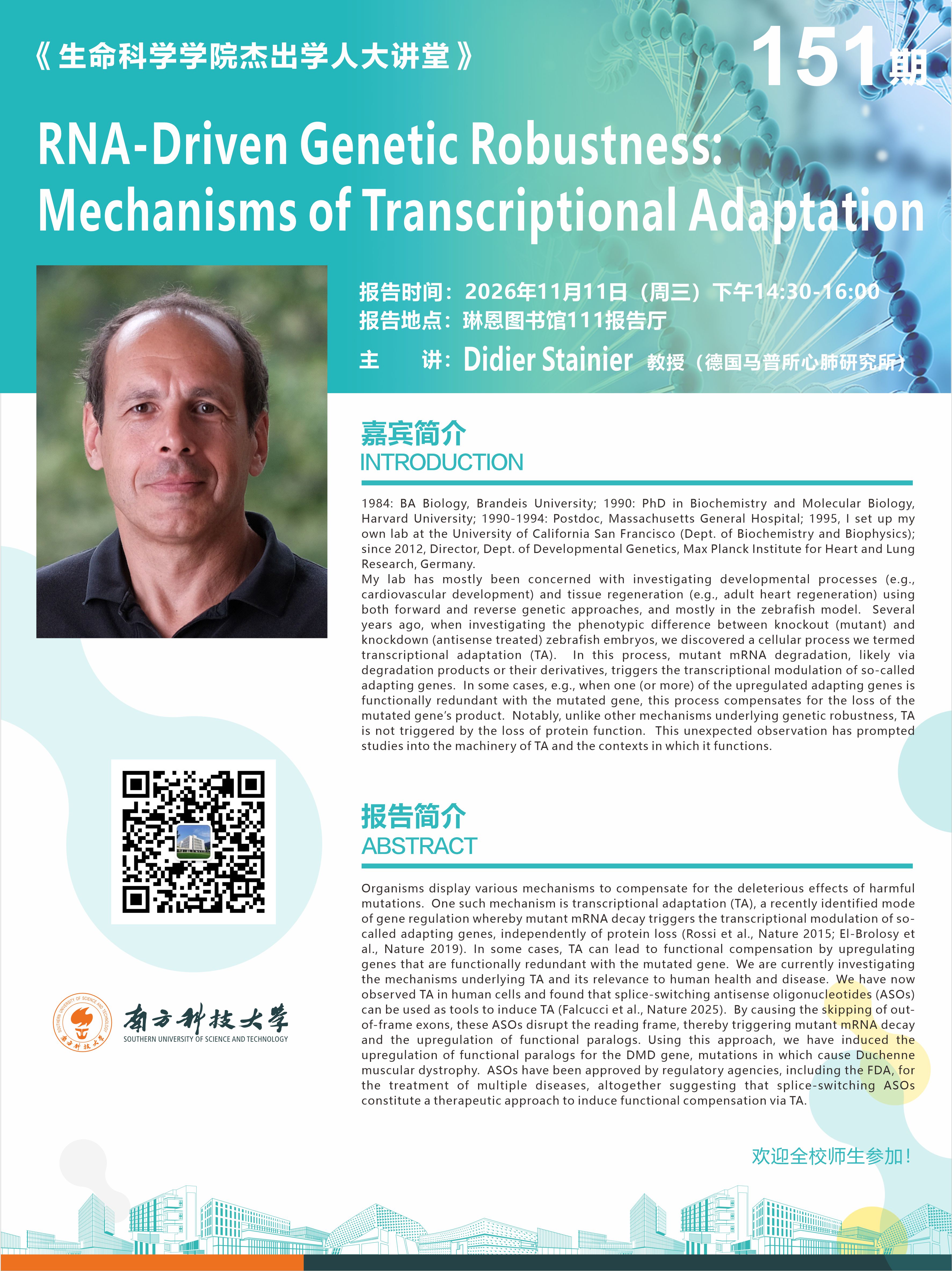
主讲人: Didier Stainier 教授
时间: 2026年11月11日14:30-16:00
地点: 琳恩图书馆111报告厅
题 目:RNA-Driven Genetic Robustness: Mechanisms of Transcriptional Adaptation
主 讲:Didier Stainier 教授
时 间:2026年11月11日(周三)下午14:30-16:00
地 点:琳恩图书馆111报告厅
报告摘要:
Organisms display various mechanisms to compensate for the deleterious effects of harmful mutations. One such mechanism is transcriptional adaptation (TA), a recently identified mode of gene regulation whereby mutant mRNA decay triggers the transcriptional modulation of so-called adapting genes, independently of protein loss (Rossi et al., Nature 2015; El-Brolosy et al., Nature 2019). In some cases, TA can lead to functional compensation by upregulating genes that are functionally redundant with the mutated gene. We are currently investigating the mechanisms underlying TA and its relevance to human health and disease. We have now observed TA in human cells and found that splice-switching antisense oligonucleotides (ASOs) can be used as tools to induce TA (Falcucci et al., Nature 2025). By causing the skipping of out-of-frame exons, these ASOs disrupt the reading frame, thereby triggering mutant mRNA decay and the upregulation of functional paralogs. Using this approach, we have induced the upregulation of functional paralogs for the DMD gene, mutations in which cause Duchenne muscular dystrophy. ASOs have been approved by regulatory agencies, including the FDA, for the treatment of multiple diseases, altogether suggesting that splice-switching ASOs constitute a therapeutic approach to induce functional compensation via TA.
嘉宾简介:
1984: BA Biology, Brandeis University; 1990: PhD in Biochemistry and Molecular Biology, Harvard University; 1990-1994: Postdoc, Massachusetts General Hospital; 1995, I set up my own lab at the University of California San Francisco (Dept. of Biochemistry and Biophysics); since 2012, Director, Dept. of Developmental Genetics, Max Planck Institute for Heart and Lung Research, Germany.
My lab has mostly been concerned with investigating developmental processes (e.g., cardiovascular development) and tissue regeneration (e.g., adult heart regeneration) using both forward and reverse genetic approaches, and mostly in the zebrafish model. Several years ago, when investigating the phenotypic difference between knockout (mutant) and knockdown (antisense treated) zebrafish embryos, we discovered a cellular process we termed transcriptional adaptation (TA). In this process, mutant mRNA degradation, likely via degradation products or their derivatives, triggers the transcriptional modulation of so-called adapting genes. In some cases, e.g., when one (or more) of the upregulated adapting genes is functionally redundant with the mutated gene, this process compensates for the loss of the mutated gene’s product. Notably, unlike other mechanisms underlying genetic robustness, TA is not triggered by the loss of protein function. This unexpected observation has prompted studies into the machinery of TA and the contexts in which it functions.