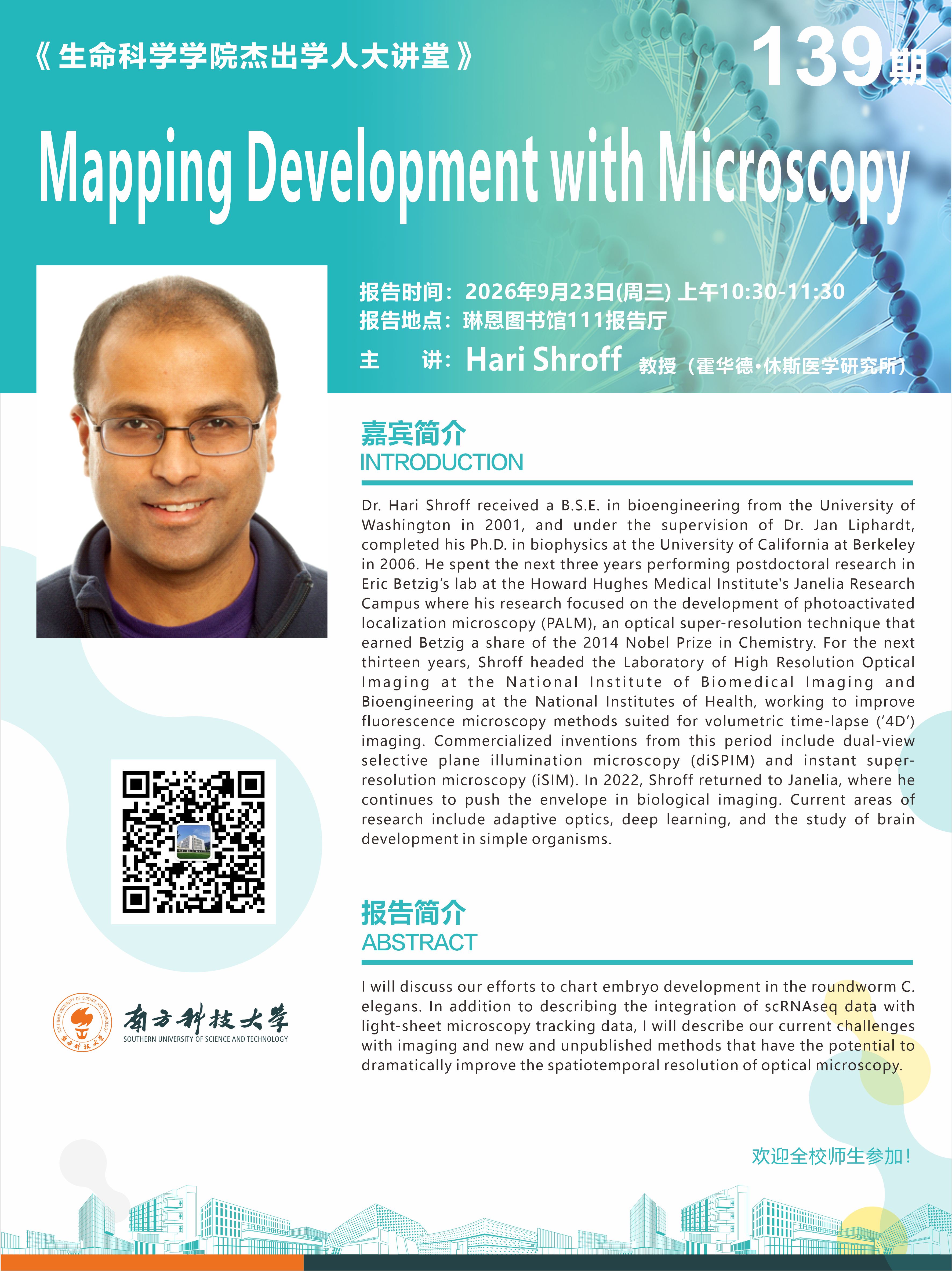
主讲人: Hari Shroff 教授(霍华德·休斯医学研究所)
时间: 2026年9月23日(周三)10:30-11:30
地点: 琳恩图书馆111报告厅
题 目:Mapping Development with Microscopy
主 讲:Hari Shroff 教授(霍华德·休斯医学研究所)
时 间:2026年9月23日(周三)10:30-11:30
地 点:琳恩图书馆111报告厅
报告摘要:
I will discuss our efforts to chart embryo development in the roundworm C. elegans. In addition to describing the integration of scRNAseq data with light-sheet microscopy tracking data, I will describe our current challenges with imaging and new and unpublished methods that have the potential to dramatically improve the spatiotemporal resolution of optical microscopy.
嘉宾简介:
Dr. Hari Shroff received a B.S.E. in bioengineering from the University of Washington in 2001, and under the supervision of Dr. Jan Liphardt, completed his Ph.D. in biophysics at the University of California at Berkeley in 2006. He spent the next three years performing postdoctoral research in Eric Betzig’s lab at the Howard Hughes Medical Institute's Janelia Research Campus where his research focused on the development of photoactivated localization microscopy (PALM), an optical super-resolution technique that earned Betzig a share of the 2014 Nobel Prize in Chemistry. For the next thirteen years, Shroff headed the Laboratory of High Resolution Optical Imaging at the National Institute of Biomedical Imaging and Bioengineering at the National Institutes of Health, working to improve fluorescence microscopy methods suited for volumetric time-lapse (‘4D’) imaging. Commercialized inventions from this period include dual-view selective plane illumination microscopy (diSPIM) and instant super-resolution microscopy (iSIM). In 2022, Shroff returned to Janelia, where he continues to push the envelope in biological imaging. Current areas of research include adaptive optics, deep learning, and the study of brain development in simple organisms.