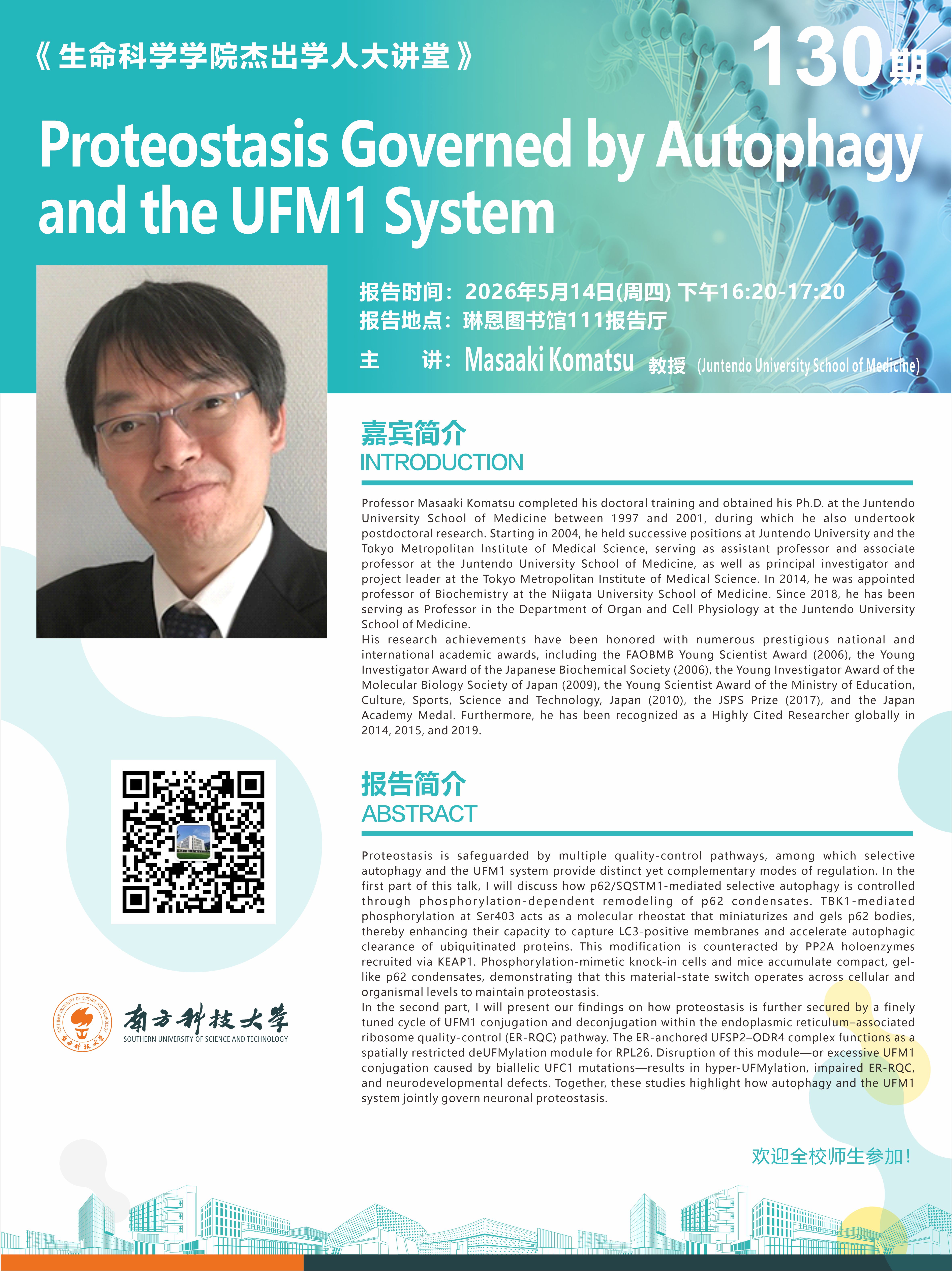
主讲人: Masaaki Komatsu 教授
时间: 2026年5月14日(周四)16:20-17:20
地点: 琳恩图书馆111报告厅
题 目:Proteostasis Governed by Autophagy and the UFM1 System
主 讲:Masaaki Komatsu 教授(Juntendo University School of Medicine)
时 间:2026年5月14日(周四)下午16:20-17:20
地 点:琳恩图书馆111报告厅
报告摘要:
Proteostasis is safeguarded by multiple quality-control pathways, among which selective autophagy and the UFM1 system provide distinct yet complementary modes of regulation. In the first part of this talk, I will discuss how p62/SQSTM1-mediated selective autophagy is controlled through phosphorylation-dependent remodeling of p62 condensates. TBK1-mediated phosphorylation at Ser403 acts as a molecular rheostat that miniaturizes and gels p62 bodies, thereby enhancing their capacity to capture LC3-positive membranes and accelerate autophagic clearance of ubiquitinated proteins. This modification is counteracted by PP2A holoenzymes recruited via KEAP1. Phosphorylation-mimetic knock-in cells and mice accumulate compact, gel-like p62 condensates, demonstrating that this material-state switch operates across cellular and organismal levels to maintain proteostasis.
In the second part, I will present our findings on how proteostasis is further secured by a finely tuned cycle of UFM1 conjugation and deconjugation within the endoplasmic reticulum–associated ribosome quality-control (ER-RQC) pathway. The ER-anchored UFSP2–ODR4 complex functions as a spatially restricted deUFMylation module for RPL26. Disruption of this module—or excessive UFM1 conjugation caused by biallelic UFC1 mutations—results in hyper-UFMylation, impaired ER-RQC, and neurodevelopmental defects. Together, these studies highlight how autophagy and the UFM1 system jointly govern neuronal proteostasis.
嘉宾简介:
Professor Masaaki Komatsu completed his doctoral training and obtained his Ph.D. at the Juntendo University School of Medicine between 1997 and 2001, during which he also undertook postdoctoral research. Starting in 2004, he held successive positions at Juntendo University and the Tokyo Metropolitan Institute of Medical Science, serving as assistant professor and associate professor at the Juntendo University School of Medicine, as well as principal investigator and project leader at the Tokyo Metropolitan Institute of Medical Science. In 2014, he was appointed professor of Biochemistry at the Niigata University School of Medicine. Since 2018, he has been serving as Professor in the Department of Organ and Cell Physiology at the Juntendo University School of Medicine.
His research achievements have been honored with numerous prestigious national and international academic awards, including the FAOBMB Young Scientist Award (2006), the Young Investigator Award of the Japanese Biochemical Society (2006), the Young Investigator Award of the Molecular Biology Society of Japan (2009), the Young Scientist Award of the Ministry of Education, Culture, Sports, Science and Technology, Japan (2010), the JSPS Prize (2017), and the Japan Academy Medal. Furthermore, he has been recognized as a Highly Cited Researcher globally in 2014, 2015, and 2019.