主讲人: 张思蕊 博士后
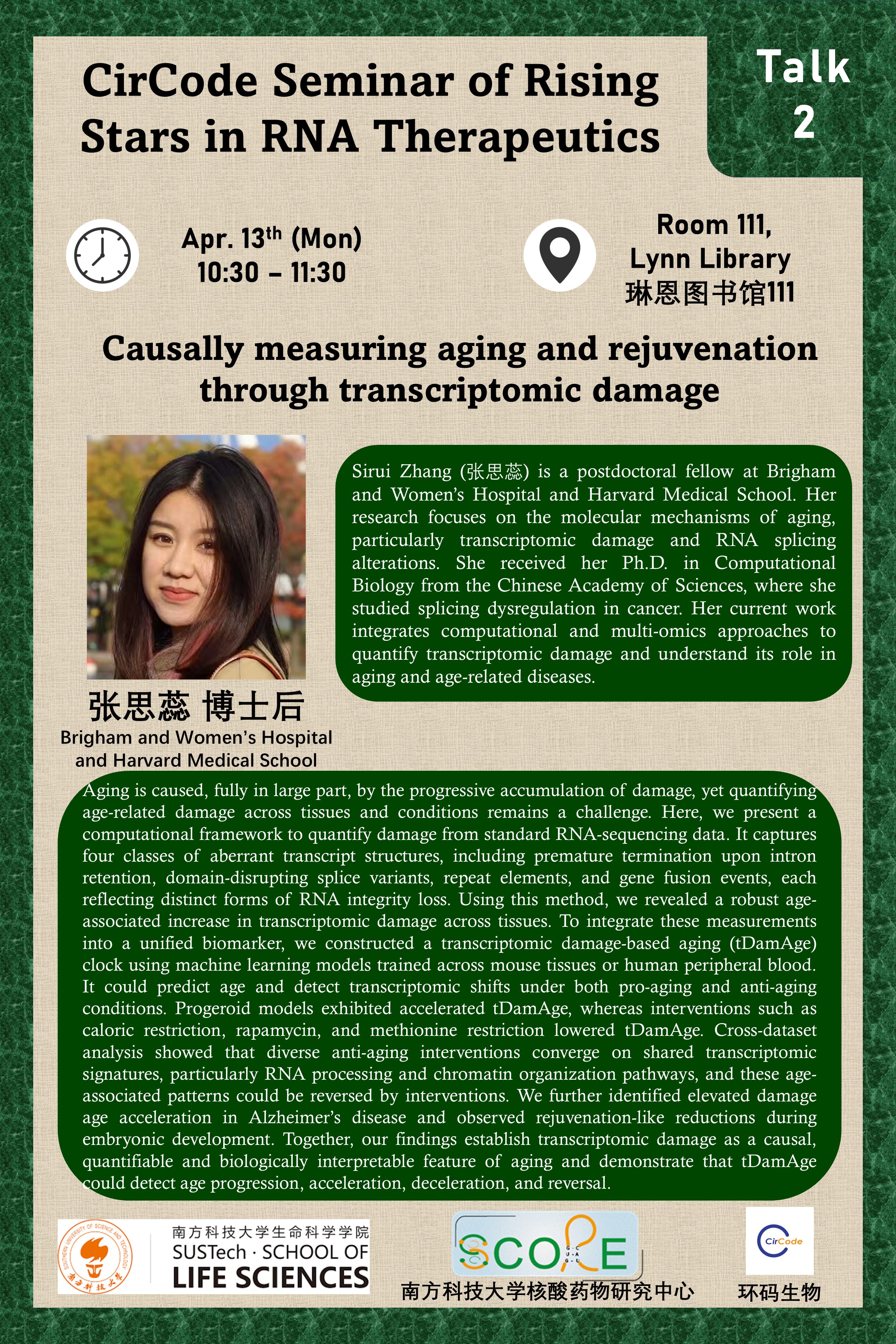
时间: 2026年4月13日(周一)上午10:30-11:30
地点: 琳恩图书馆111报告厅
题 目:Causally measuring aging and rejuvenation through transcriptomic damage
主 讲:张思蕊 博士后
时 间:2026年4月13日(周一)上午10:30-11:30
地 点:琳恩图书馆111报告厅
报告摘要:
Aging is caused, fully in large part, by the progressive accumulation of damage, yet quantifying age-related damage across tissues and conditions remains a challenge. Here, we present a computational framework to quantify damage from standard RNA-sequencing data. It captures four classes of aberrant transcript structures, including premature termination upon intron retention, domain-disrupting splice variants, repeat elements, and gene fusion events, each reflecting distinct forms of RNA integrity loss. Using this method, we revealed a robust age-associated increase in transcriptomic damage across tissues. To integrate these measurements into a unified biomarker, we constructed a transcriptomic damage-based aging (tDamAge) clock using machine learning models trained across mouse tissues or human peripheral blood. It could predict age and detect transcriptomic shifts under both pro-aging and anti-aging conditions. Progeroid models exhibited accelerated tDamAge, whereas interventions such as caloric restriction, rapamycin, and methionine restriction lowered tDamAge. Cross-dataset analysis showed that diverse anti-aging interventions converge on shared transcriptomic signatures, particularly RNA processing and chromatin organization pathways, and these age-associated patterns could be reversed by interventions. We further identified elevated damage age acceleration in Alzheimer’s disease and observed rejuvenation-like reductions during embryonic development. Together, our findings establish transcriptomic damage as a causal, quantifiable and biologically interpretable feature of aging and demonstrate that tDamAge could detect age progression, acceleration, deceleration, and reversal.
个人简介:
Sirui Zhang (张思蕊) is a postdoctoral fellow at Brigham and Women’s Hospital and Harvard Medical School. Her research focuses on the molecular mechanisms of aging, particularly transcriptomic damage and RNA splicing alterations. She received her Ph.D. in Computational Biology from the Chinese Academy of Sciences, where she studied splicing dysregulation in cancer. Her current work integrates computational and multi-omics approaches to quantify transcriptomic damage and understand its role in aging and age-related diseases.