
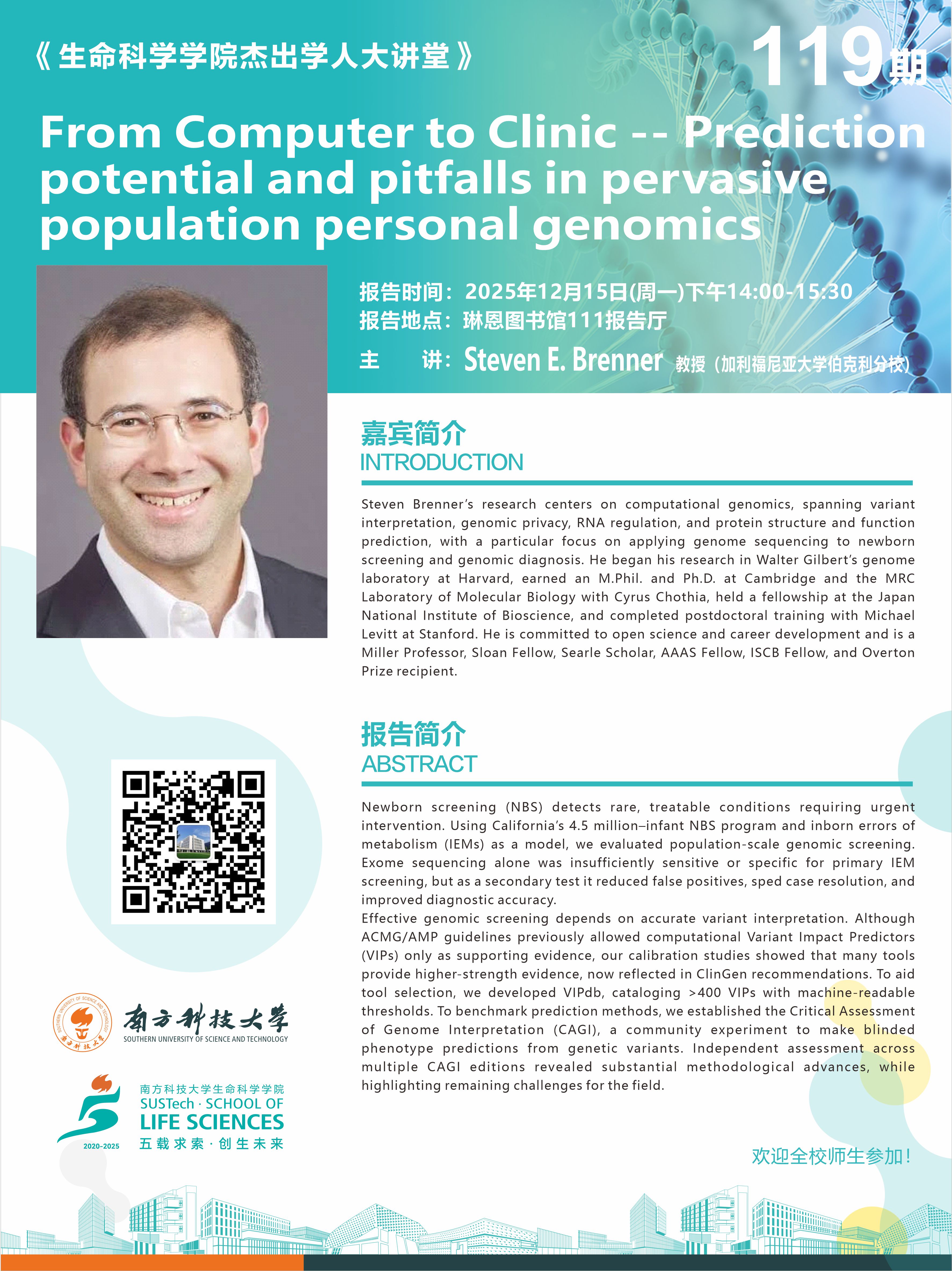
主讲人: Steven E. Brenner 教授
时间: 2025年12月15日(周一)14:00-15:30
地点: 琳恩图书馆111报告厅
题 目:From Computer to Clinic -- Prediction potential and pitfalls in pervasive population personal genomics
主 讲:Steven E. Brenner 教授
时 间:2025年12月15日(周一)下午14:00-15:30
地 点:琳恩图书馆111报告厅
个人简介:
Steven Brenner’s research centers on computational genomics, spanning variant interpretation, genomic privacy, RNA regulation, and protein structure and function prediction, with a particular focus on applying genome sequencing to newborn screening and genomic diagnosis. He began his research in Walter Gilbert’s genome laboratory at Harvard, earned an M.Phil. and Ph.D. at Cambridge and the MRC Laboratory of Molecular Biology with Cyrus Chothia, held a fellowship at the Japan National Institute of Bioscience, and completed postdoctoral training with Michael Levitt at Stanford. He is committed to open science and career development and is a Miller Professor, Sloan Fellow, Searle Scholar, AAAS Fellow, ISCB Fellow, and Overton Prize recipient.
报告摘要:
Newborn screening (NBS) detects rare, treatable conditions requiring urgent intervention. Using California’s 4.5 million–infant NBS program and inborn errors of metabolism (IEMs) as a model, we evaluated population-scale genomic screening. Exome sequencing alone was insufficiently sensitive or specific for primary IEM screening, but as a secondary test it reduced false positives, sped case resolution, and improved diagnostic accuracy.
Effective genomic screening depends on accurate variant interpretation. Although ACMG/AMP guidelines previously allowed computational Variant Impact Predictors (VIPs) only as supporting evidence, our calibration studies showed that many tools provide higher-strength evidence, now reflected in ClinGen recommendations. To aid tool selection, we developed VIPdb, cataloging >400 VIPs with machine-readable thresholds. To benchmark prediction methods, we established the Critical Assessment of Genome Interpretation (CAGI), a community experiment to make blinded phenotype predictions from genetic variants. Independent assessment across multiple CAGI editions revealed substantial methodological advances, while highlighting remaining challenges for the field.