
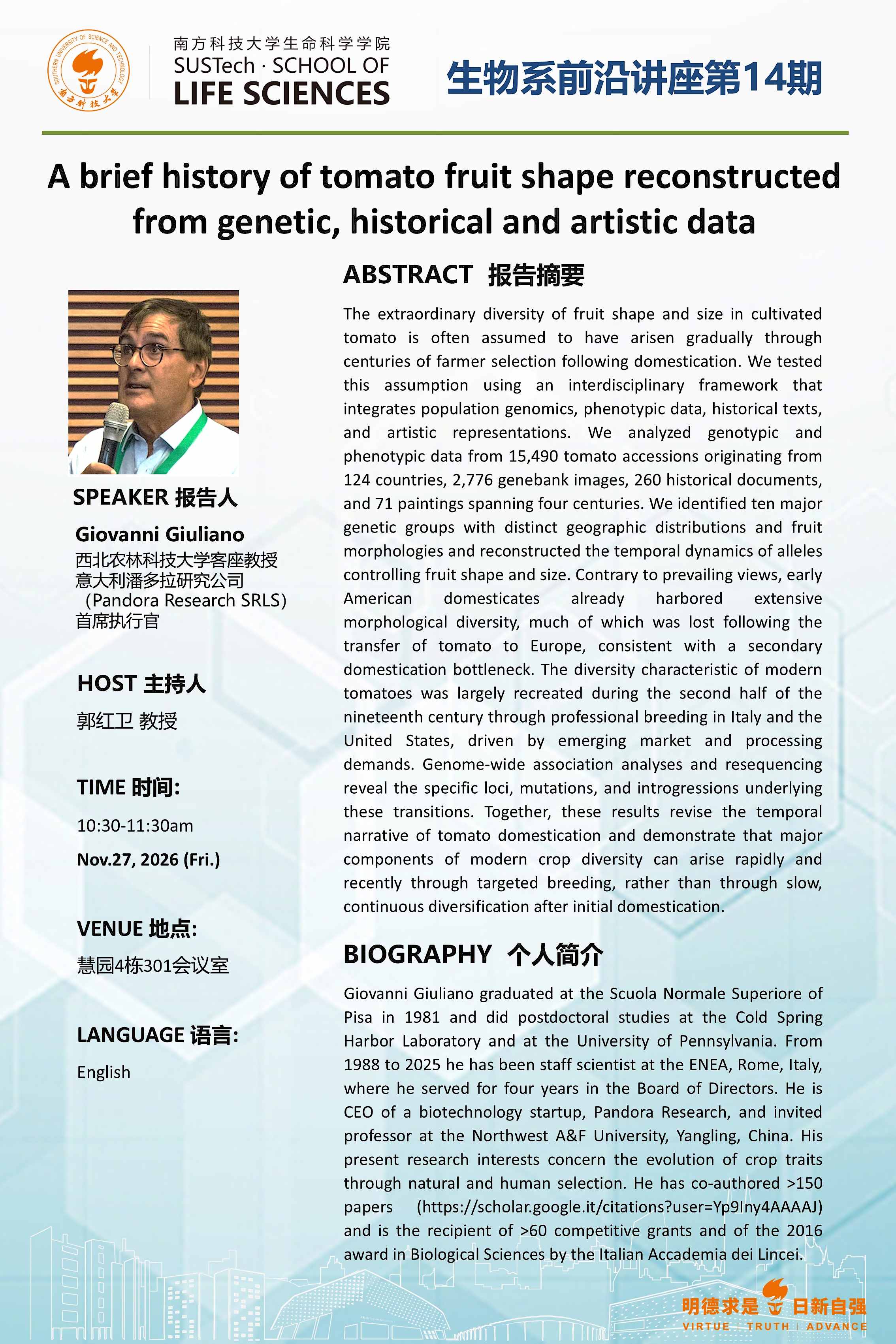
主讲人: Giovanni Giuliano
时间: 2026年11月27日10:00-11:00
地点: 慧园4栋301会议室
题目:A brief history of tomato fruit shape reconstructed from genetic, historical and artistic data
主讲:Giovanni Giuliano [西北农林科技大学客座教授,意大利潘多拉研究公司(Pandora Research SRLS)首席执行官]
时间:11月27日(周五)上午10:00-11:00
地点:慧园4栋301会议室
个人简介:
Giovanni Giuliano graduated at the Scuola Normale Superiore of Pisa in 1981 and did postdoctoral studies at the Cold Spring Harbor Laboratory and at the University of Pennsylvania. From 1988 to 2025 he has been staff scientist at the ENEA, Rome, Italy, where he served for four years in the Board of Directors. He is CEO of a biotechnology startup, Pandora Research, and invited professor at the Northwest A&F University, Yangling, China. His present research interests concern the evolution of crop traits through natural and human selection. He has co-authored >150 papers (https://scholar.google.it/citations?user=Yp9Iny4AAAAJ) and is the recipient of >60 competitive grants and of the 2016 award in Biological Sciences by the Italian Accademia dei Lincei.
报告摘要:
The extraordinary diversity of fruit shape and size in cultivated tomato is often assumed to have arisen gradually through centuries of farmer selection following domestication. We tested this assumption using an interdisciplinary framework that integrates population genomics, phenotypic data, historical texts, and artistic representations. We analyzed genotypic and phenotypic data from 15,490 tomato accessions originating from 124 countries, 2,776 genebank images, 260 historical documents, and 71 paintings spanning four centuries. We identified ten major genetic groups with distinct geographic distributions and fruit morphologies and reconstructed the temporal dynamics of alleles controlling fruit shape and size. Contrary to prevailing views, early American domesticates already harbored extensive morphological diversity, much of which was lost following the transfer of tomato to Europe, consistent with a secondary domestication bottleneck. The diversity characteristic of modern tomatoes was largely recreated during the second half of the nineteenth century through professional breeding in Italy and the United States, driven by emerging market and processing demands. Genome-wide association analyses and resequencing reveal the specific loci, mutations, and introgressions underlying these transitions. Together, these results revise the temporal narrative of tomato domestication and demonstrate that major components of modern crop diversity can arise rapidly and recently through targeted breeding, rather than through slow, continuous diversification after initial domestication.