
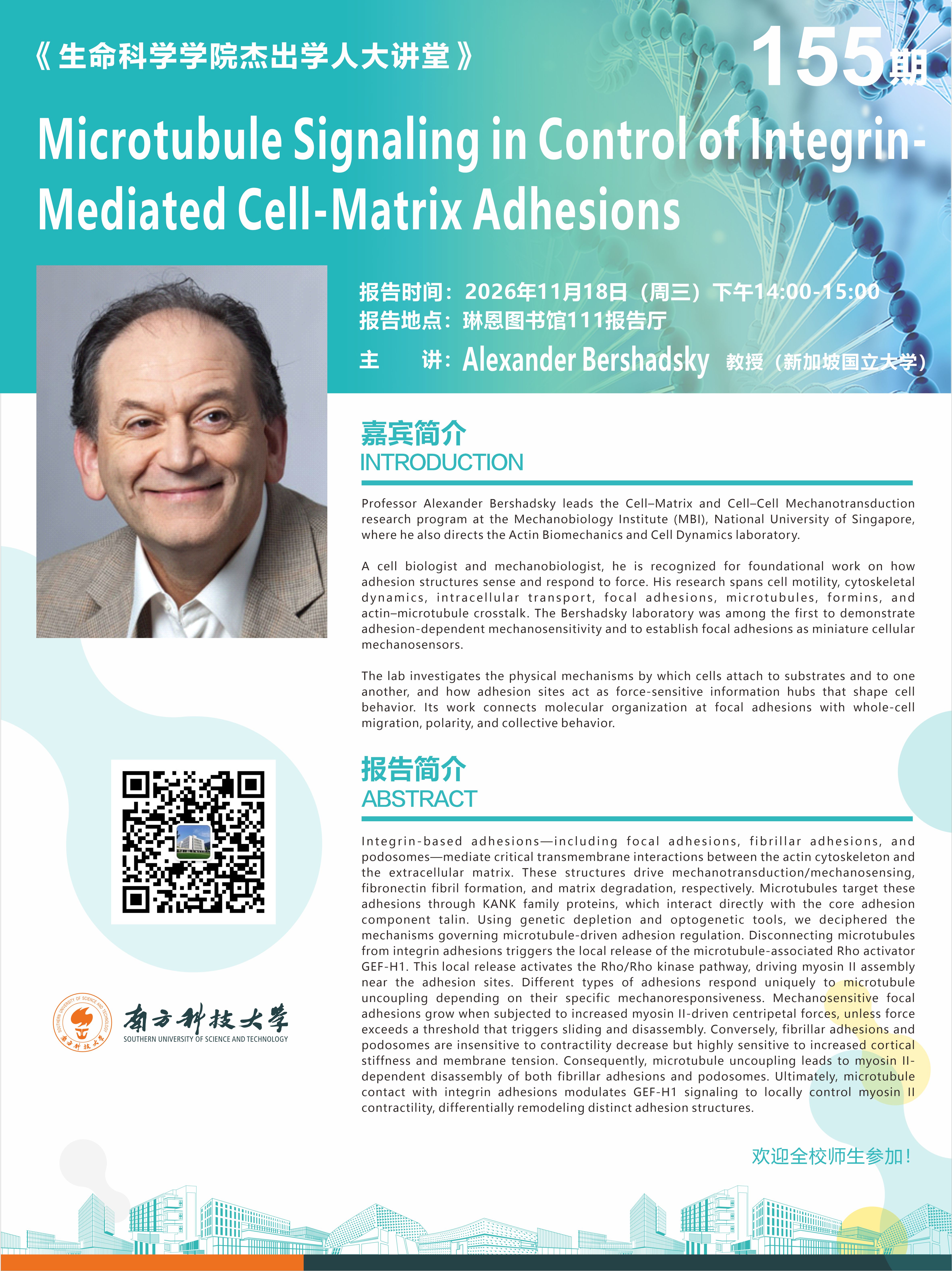
主讲人: Alexander Bershadsky 教授
时间: 2026年11月18日14:00-15:00
地点: 琳恩图书馆111报告厅
题 目:Microtubule Signaling in Control of Integrin-Mediated Cell-Matrix Adhesions
主 讲:Alexander Bershadsky 教授(新加坡国立大学)
时 间:2026年11月18日(周三)下午14:00-15:00
地 点:琳恩图书馆111报告厅
报告摘要:
Integrin-based adhesions—including focal adhesions, fibrillar adhesions, and podosomes—mediate critical transmembrane interactions between the actin cytoskeleton and the extracellular matrix. These structures drive mechanotransduction/mechanosensing, fibronectin fibril formation, and matrix degradation, respectively. Microtubules target these adhesions through KANK family proteins, which interact directly with the core adhesion component talin. Using genetic depletion and optogenetic tools, we deciphered the mechanisms governing microtubule-driven adhesion regulation. Disconnecting microtubules from integrin adhesions triggers the local release of the microtubule-associated Rho activator GEF-H1. This local release activates the Rho/Rho kinase pathway, driving myosin II assembly near the adhesion sites. Different types of adhesions respond uniquely to microtubule uncoupling depending on their specific mechanoresponsiveness. Mechanosensitive focal adhesions grow when subjected to increased myosin II-driven centripetal forces, unless force exceeds a threshold that triggers sliding and disassembly. Conversely, fibrillar adhesions and podosomes are insensitive to contractility decrease but highly sensitive to increased cortical stiffness and membrane tension. Consequently, microtubule uncoupling leads to myosin II-dependent disassembly of both fibrillar adhesions and podosomes. Ultimately, microtubule contact with integrin adhesions modulates GEF-H1 signaling to locally control myosin II contractility, differentially remodeling distinct adhesion structures.
嘉宾简介:
Professor Alexander Bershadsky leads the Cell–Matrix and Cell–Cell Mechanotransduction research program at the Mechanobiology Institute (MBI), National University of Singapore, where he also directs the Actin Biomechanics and Cell Dynamics laboratory.
A cell biologist and mechanobiologist, he is recognized for foundational work on how adhesion structures sense and respond to force. His research spans cell motility, cytoskeletal dynamics, intracellular transport, focal adhesions, microtubules, formins, and actin–microtubule crosstalk. The Bershadsky laboratory was among the first to demonstrate adhesion-dependent mechanosensitivity and to establish focal adhesions as miniature cellular mechanosensors.
The lab investigates the physical mechanisms by which cells attach to substrates and to one another, and how adhesion sites act as force-sensitive information hubs that shape cell behavior. Its work connects molecular organization at focal adhesions with whole-cell migration, polarity, and collective behavior.