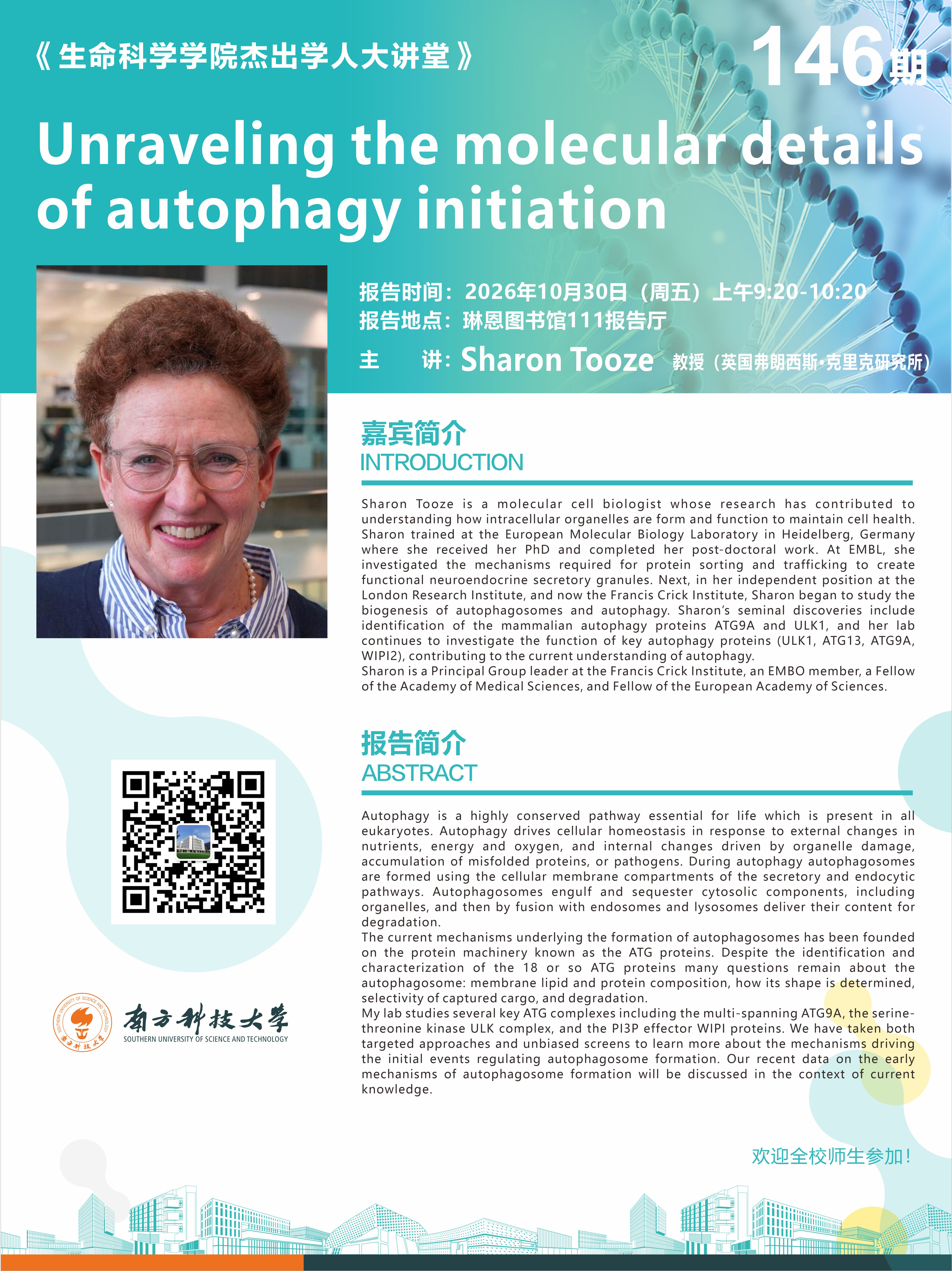
主讲人: Sharon Tooze 教授
时间: 2026年10月30日9:20-10:20
地点: 琳恩图书馆111报告厅
题 目:Unraveling the molecular details of autophagy initiation
主 讲:Sharon Tooze 教授(英国弗朗西斯·克里克研究所)
时 间:2026年10月30日(周五)上午9:20-10:20
地 点:琳恩图书馆111报告厅
报告摘要:
Autophagy is a highly conserved pathway essential for life which is present in all eukaryotes. Autophagy drives cellular homeostasis in response to external changes in nutrients, energy and oxygen, and internal changes driven by organelle damage, accumulation of misfolded proteins, or pathogens. During autophagy autophagosomes are formed using the cellular membrane compartments of the secretory and endocytic pathways. Autophagosomes engulf and sequester cytosolic components, including organelles, and then by fusion with endosomes and lysosomes deliver their content for degradation.
The current mechanisms underlying the formation of autophagosomes has been founded on the protein machinery known as the ATG proteins. Despite the identification and characterization of the 18 or so ATG proteins many questions remain about the autophagosome: membrane lipid and protein composition, how its shape is determined, selectivity of captured cargo, and degradation.
My lab studies several key ATG complexes including the multi-spanning ATG9A, the serine-threonine kinase ULK complex, and the PI3P effector WIPI proteins. We have taken both targeted approaches and unbiased screens to learn more about the mechanisms driving the initial events regulating autophagosome formation. Our recent data on the early mechanisms of autophagosome formation will be discussed in the context of current knowledge.
嘉宾简介:
Sharon Tooze is a molecular cell biologist whose research has contributed to understanding how intracellular organelles are form and function to maintain cell health. Sharon trained at the European Molecular Biology Laboratory in Heidelberg, Germany where she received her PhD and completed her post-doctoral work. At EMBL, she investigated the mechanisms required for protein sorting and trafficking to create functional neuroendocrine secretory granules. Next, in her independent position at the London Research Institute, and now the Francis Crick Institute, Sharon began to study the biogenesis of autophagosomes and autophagy. Sharon’s seminal discoveries include identification of the mammalian autophagy proteins ATG9A and ULK1, and her lab continues to investigate the function of key autophagy proteins (ULK1, ATG13, ATG9A, WIPI2), contributing to the current understanding of autophagy.
Sharon is a Principal Group leader at the Francis Crick Institute, an EMBO member, a Fellow of the Academy of Medical Sciences, and Fellow of the European Academy of Sciences.