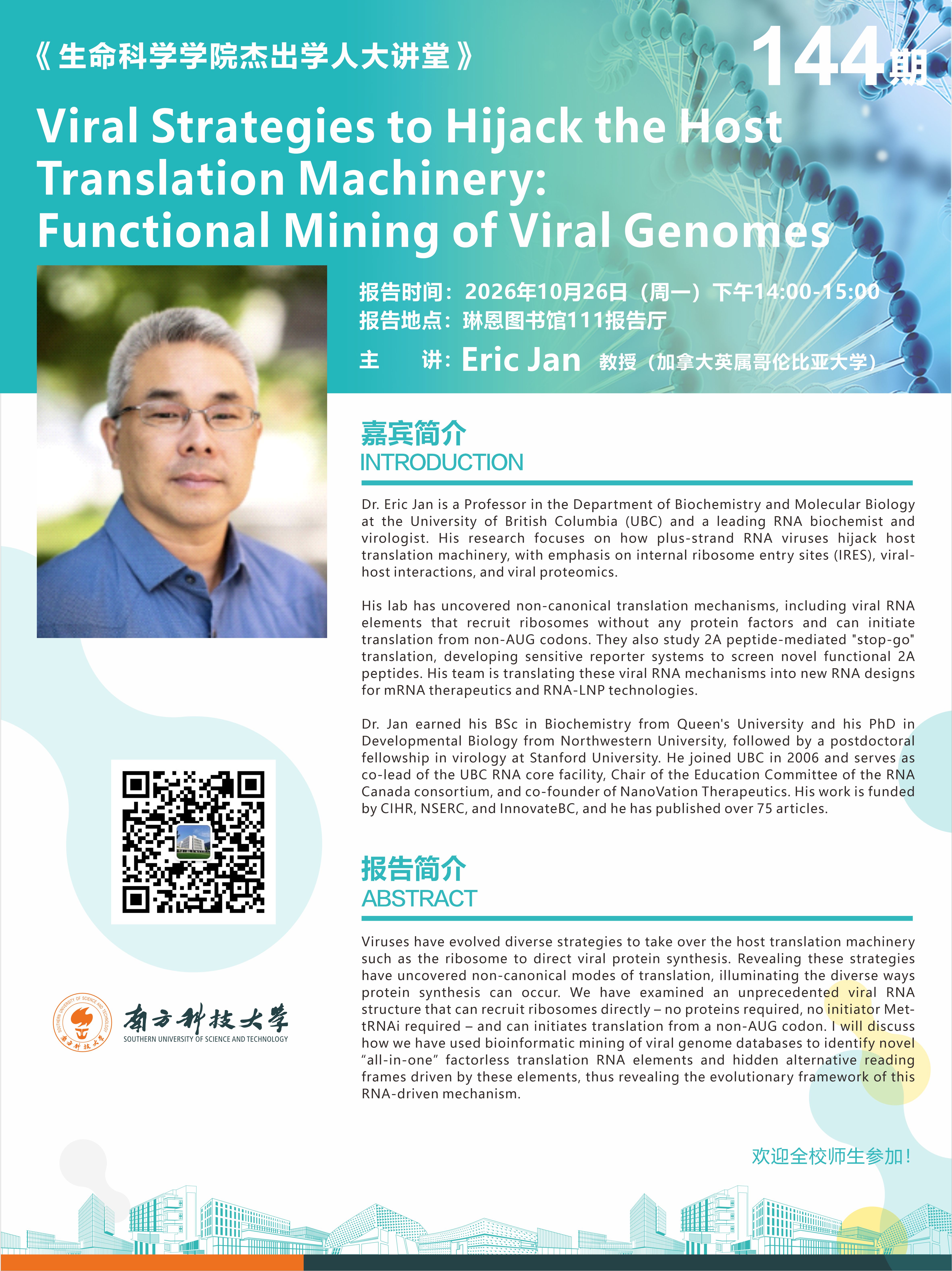
主讲人: Eric Jan 教授
时间: 2026年10月26日(周一)14:00-15:00
地点: 琳恩图书馆111报告厅
题 目:Viral Strategies to Hijack the Host Translation Machinery: Functional Mining of Viral Genomes
主 讲:Eric Jan 教授(加拿大英属哥伦比亚大学)
时 间:2026年10月26日(周一)下午14:00-15:00
地 点:琳恩图书馆111报告厅
报告摘要:
Viruses have evolved diverse strategies to take over the host translation machinery such as the ribosome to direct viral protein synthesis. Revealing these strategies have uncovered non-canonical modes of translation, illuminating the diverse ways protein synthesis can occur. We have examined an unprecedented viral RNA structure that can recruit ribosomes directly – no proteins required, no initiator Met-tRNAi required – and can initiates translation from a non-AUG codon. I will discuss how we have used bioinformatic mining of viral genome databases to identify novel “all-in-one” factorless translation RNA elements and hidden alternative reading frames driven by these elements, thus revealing the evolutionary framework of this RNA-driven mechanism.
嘉宾简介:
Dr. Eric Jan is a Professor in the Department of Biochemistry and Molecular Biology at the University of British Columbia (UBC) and a leading RNA biochemist and virologist. His research focuses on how plus-strand RNA viruses hijack host translation machinery, with emphasis on internal ribosome entry sites (IRES), viral-host interactions, and viral proteomics.
His lab has uncovered non-canonical translation mechanisms, including viral RNA elements that recruit ribosomes without any protein factors and can initiate translation from non-AUG codons. They also study 2A peptide-mediated "stop-go" translation, developing sensitive reporter systems to screen novel functional 2A peptides. His team is translating these viral RNA mechanisms into new RNA designs for mRNA therapeutics and RNA-LNP technologies.
Dr. Jan earned his BSc in Biochemistry from Queen's University and his PhD in Developmental Biology from Northwestern University, followed by a postdoctoral fellowship in virology at Stanford University. He joined UBC in 2006 and serves as co-lead of the UBC RNA core facility, Chair of the Education Committee of the RNA Canada consortium, and co-founder of NanoVation Therapeutics. His work is funded by CIHR, NSERC, and InnovateBC, and he has published over 75 articles.