主讲人: 许献忠 资深研究员
时间: 2026年10月21日(周三)14:00-15:00
地点: 琳恩图书馆111报告厅
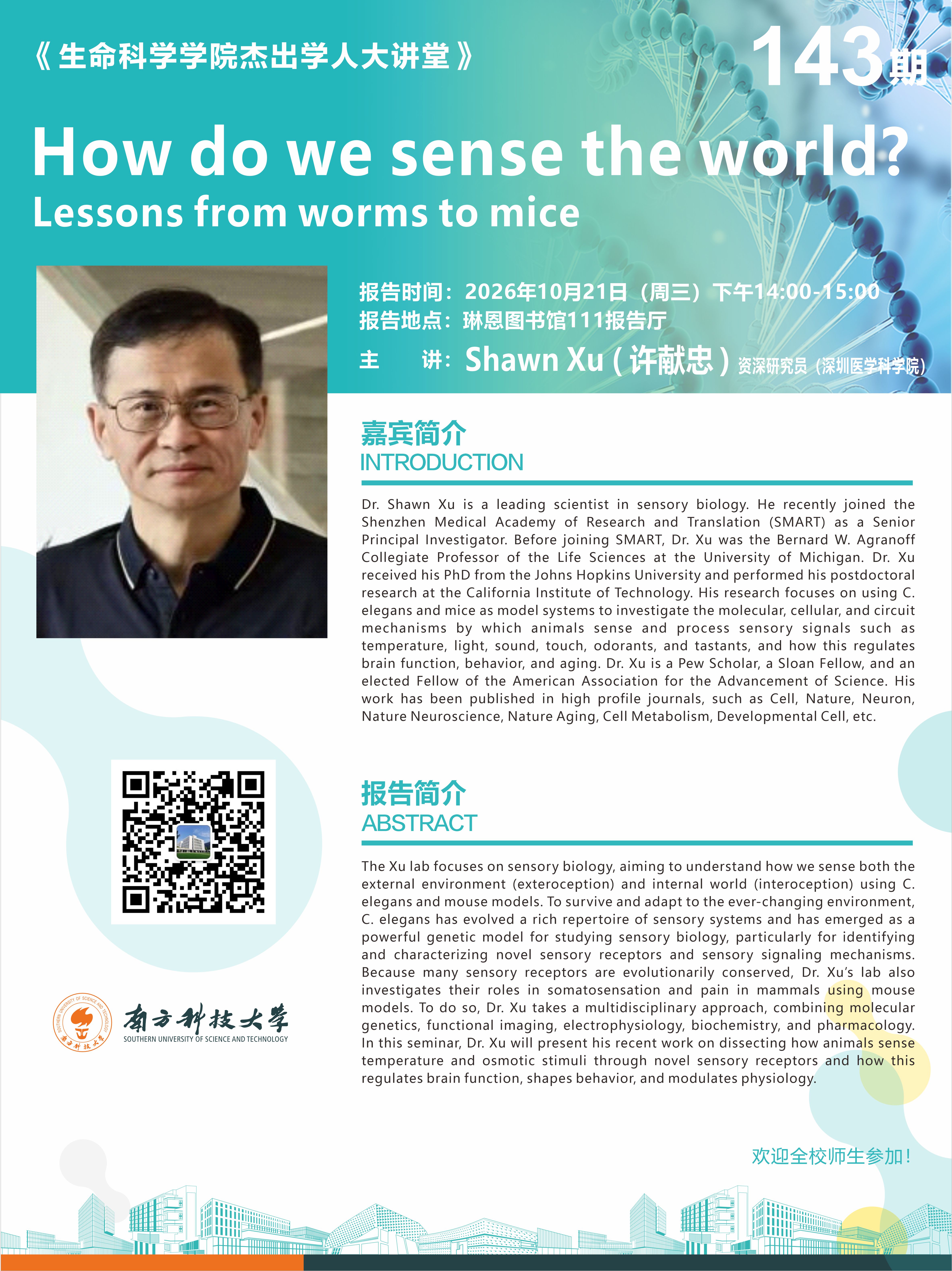
题 目:How do we sense the world? Lessons from worms to mice
主 讲:许献忠 资深研究员
时 间:2026年10月21日(周三)下午14:00-15:00
地 点:琳恩图书馆111报告厅
报告摘要:
The Xu lab focuses on sensory biology, aiming to understand how we sense both the external environment (exteroception) and internal world (interoception) using C. elegans and mouse models. To survive and adapt to the ever-changing environment, C. elegans has evolved a rich repertoire of sensory systems and has emerged as a powerful genetic model for studying sensory biology, particularly for identifying and characterizing novel sensory receptors and sensory signaling mechanisms. Because many sensory receptors are evolutionarily conserved, Dr. Xu’s lab also investigates their roles in somatosensation and pain in mammals using mouse models. To do so, Dr. Xu takes a multidisciplinary approach, combining molecular genetics, functional imaging, electrophysiology, biochemistry, and pharmacology. In this seminar, Dr. Xu will present his recent work on dissecting how animals sense temperature and osmotic stimuli through novel sensory receptors and how this regulates brain function, shapes behavior, and modulates physiology.
嘉宾简介:
Dr. Shawn Xu is a leading scientist in sensory biology. He recently joined the Shenzhen Medical Academy of Research and Translation (SMART) as a Senior Principal Investigator. Before joining SMART, Dr. Xu was the Bernard W. Agranoff Collegiate Professor of the Life Sciences at the University of Michigan. Dr. Xu received his PhD from the Johns Hopkins University and performed his postdoctoral research at the California Institute of Technology. His research focuses on using C. elegans and mice as model systems to investigate the molecular, cellular, and circuit mechanisms by which animals sense and process sensory signals such as temperature, light, sound, touch, odorants, and tastants, and how this regulates brain function, behavior, and aging. Dr. Xu is a Pew Scholar, a Sloan Fellow, and an elected Fellow of the American Association for the Advancement of Science. His work has been published in high profile journals, such as Cell, Nature, Neuron, Nature Neuroscience, Nature Aging, Cell Metabolism, Developmental Cell, etc.