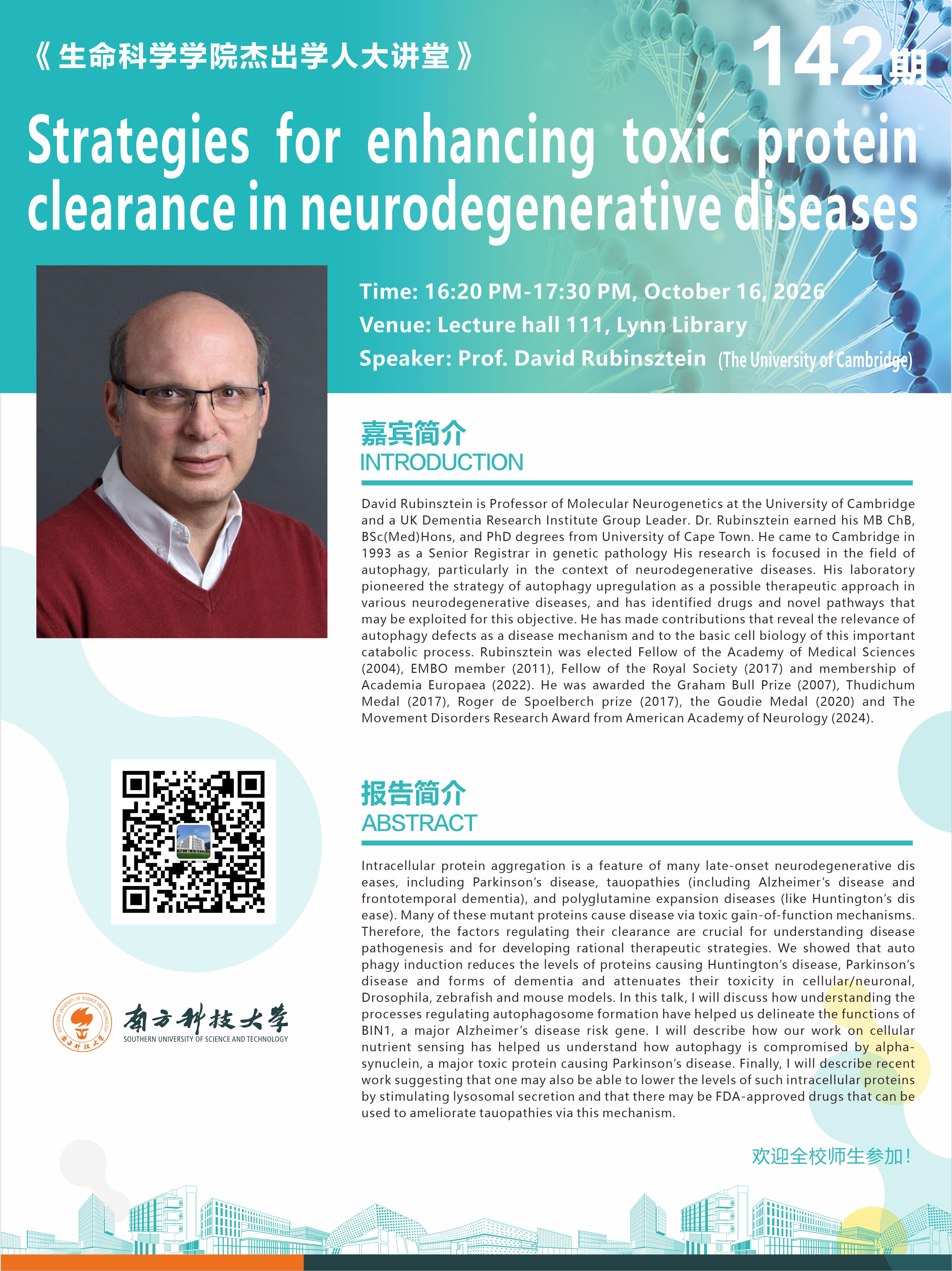
主讲人: David Rubinsztein 院士
时间: 2026年10月16日(周五)16:20-17:30
地点: 琳恩图书馆111报告厅
题 目:Strategies for enhancing toxic protein clearance in neurodegenerative diseases
主 讲:David Rubinsztein 院士
时 间:2026年10月16日(周五)下午16:20-17:30
地 点:琳恩图书馆111报告厅
报告摘要:
Intracellular protein aggregation is a feature of many late-onset neurodegenerative diseases, including Parkinson’s disease, tauopathies (including Alzheimer’s disease and frontotemporal dementia), and polyglutamine expansion diseases (like Huntington’s disease). Many of these mutant proteins cause disease via toxic gain-of-function mechanisms. Therefore, the factors regulating their clearance are crucial for understanding disease pathogenesis and for developing rational therapeutic strategies. We showed that autophagy induction reduces the levels of proteins causing Huntington’s disease, Parkinson’s disease and forms of dementia and attenuates their toxicity in cellular/neuronal, Drosophila, zebrafish and mouse models. In this talk, I will discuss how understanding the processes regulating autophagosome formation have helped us delineate the functions of BIN1, a major Alzheimer’s disease risk gene. I will describe how our work on cellular nutrient sensing has helped us understand how autophagy is compromised by alpha-synuclein, a major toxic protein causing Parkinson’s disease. Finally, I will describe recent work suggesting that one may also be able to lower the levels of such intracellular proteins by stimulating lysosomal secretion and that there may be FDA-approved drugs that can be used to ameliorate tauopathies via this mechanism.
嘉宾简介:
David Rubinsztein is Professor of Molecular Neurogenetics at the University of Cambridge and a UK Dementia Research Institute Group Leader. Dr. Rubinsztein earned his MB ChB, BSc(Med)Hons, and PhD degrees from University of Cape Town. He came to Cambridge in 1993 as a Senior Registrar in genetic pathology. His research is focused in the field of autophagy, particularly in the context of neurodegenerative diseases. His laboratory pioneered the strategy of autophagy upregulation as a possible therapeutic approach in various neurodegenerative diseases, and has identified drugs and novel pathways that may be exploited for this objective. He has made contributions that reveal the relevance of autophagy defects as a disease mechanism and to the basic cell biology of this important catabolic process. Rubinsztein was elected Fellow of the Academy of Medical Sciences (2004), EMBO member (2011), Fellow of the Royal Society (2017) and membership of Academia Europaea (2022). He was awarded the Graham Bull Prize (2007), Thudichum Medal (2017), Roger de Spoelberch prize (2017), the Goudie Medal (2020) and The Movement Disorders Research Award from American Academy of Neurology (2024).