
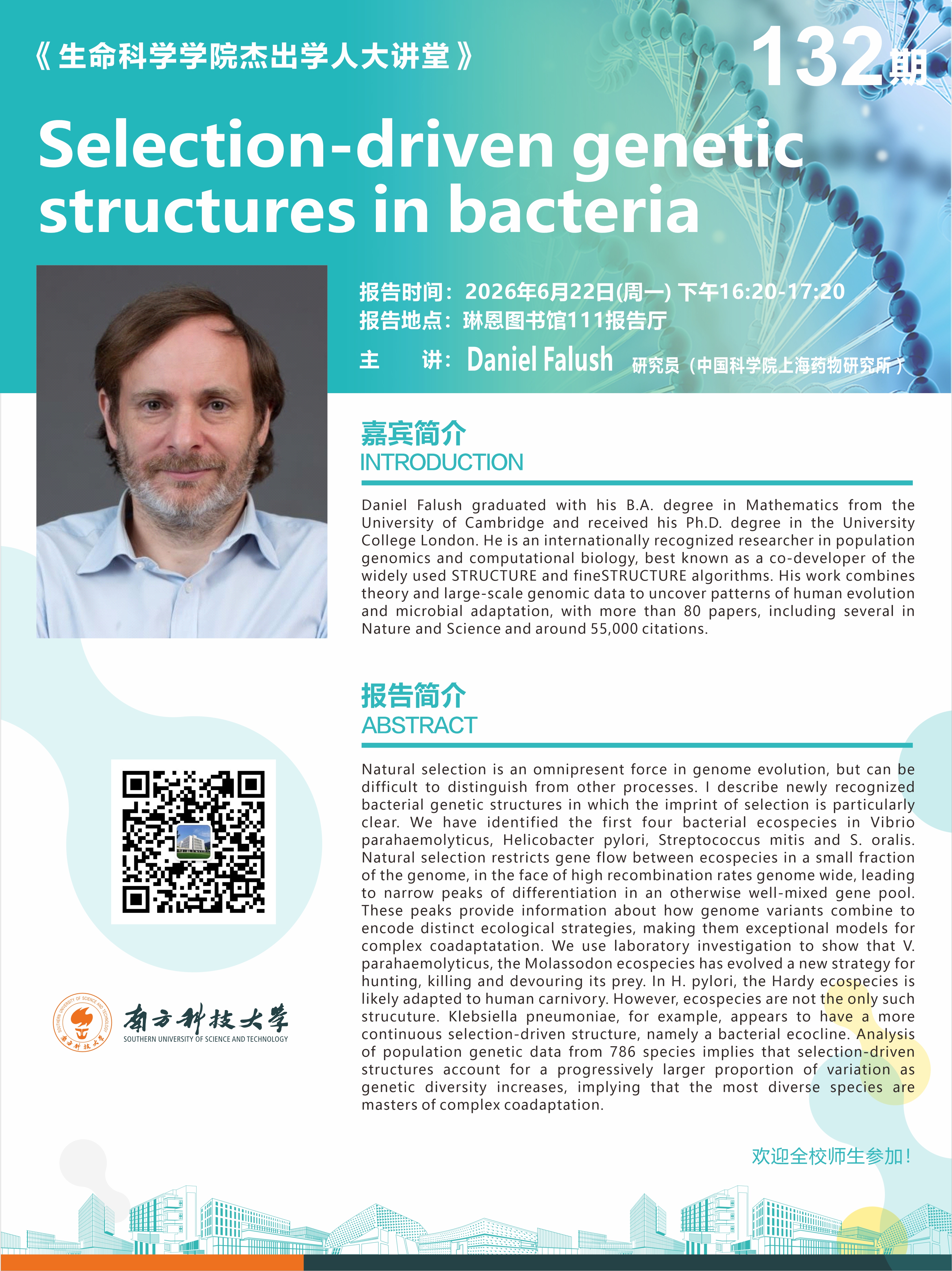
主讲人: Daniel Falush 研究员
时间: 2026年6月22日(周一)16:20-17:20
地点: 琳恩图书馆111报告厅
题 目:Selection-driven genetic structures in bacteria
主 讲:Daniel Falush 研究员(中国科学院上海药物研究所 )
时 间:2026年6月22日(周一)下午16:20-17:20
地 点:琳恩图书馆111报告厅
报告摘要:
Natural selection is an omnipresent force in genome evolution, but can be difficult to distinguish from other processes. I describe newly recognized bacterial genetic structures in which the imprint of selection is particularly clear. We have identified the first four bacterial ecospecies in Vibrio parahaemolyticus, Helicobacter pylori, Streptococcus mitis and S. oralis. Natural selection restricts gene flow between ecospecies in a small fraction of the genome, in the face of high recombination rates genome wide, leading to narrow peaks of differentiation in an otherwise well-mixed gene pool. These peaks provide information about how genome variants combine to encode distinct ecological strategies, making them exceptional models for complex coadaptatation. We use laboratory investigation to show that V. parahaemolyticus, the Molassodon ecospecies has evolved a new strategy for hunting, killing and devouring its prey. In H. pylori, the Hardy ecospecies is likely adapted to human carnivory. However, ecospecies are not the only such strucuture. Klebsiella pneumoniae, for example, appears to have a more continuous selection-driven structure, namely a bacterial ecocline. Analysis of population genetic data from 786 species implies that selection-driven structures account for a progressively larger proportion of variation as genetic diversity increases, implying that the most diverse species are masters of complex coadaptation.
嘉宾简介:
Daniel Falush graduated with his B.A. degree in Mathematics from the University of Cambridge and received his Ph.D. degree in the University College London. He is an internationally recognized researcher in population genomics and computational biology, best known as a co-developer of the widely used STRUCTURE and fineSTRUCTURE algorithms. His work combines theory and large-scale genomic data to uncover patterns of human evolution and microbial adaptation, with more than 80 papers, including several in Nature and Science and around 55,000 citations.