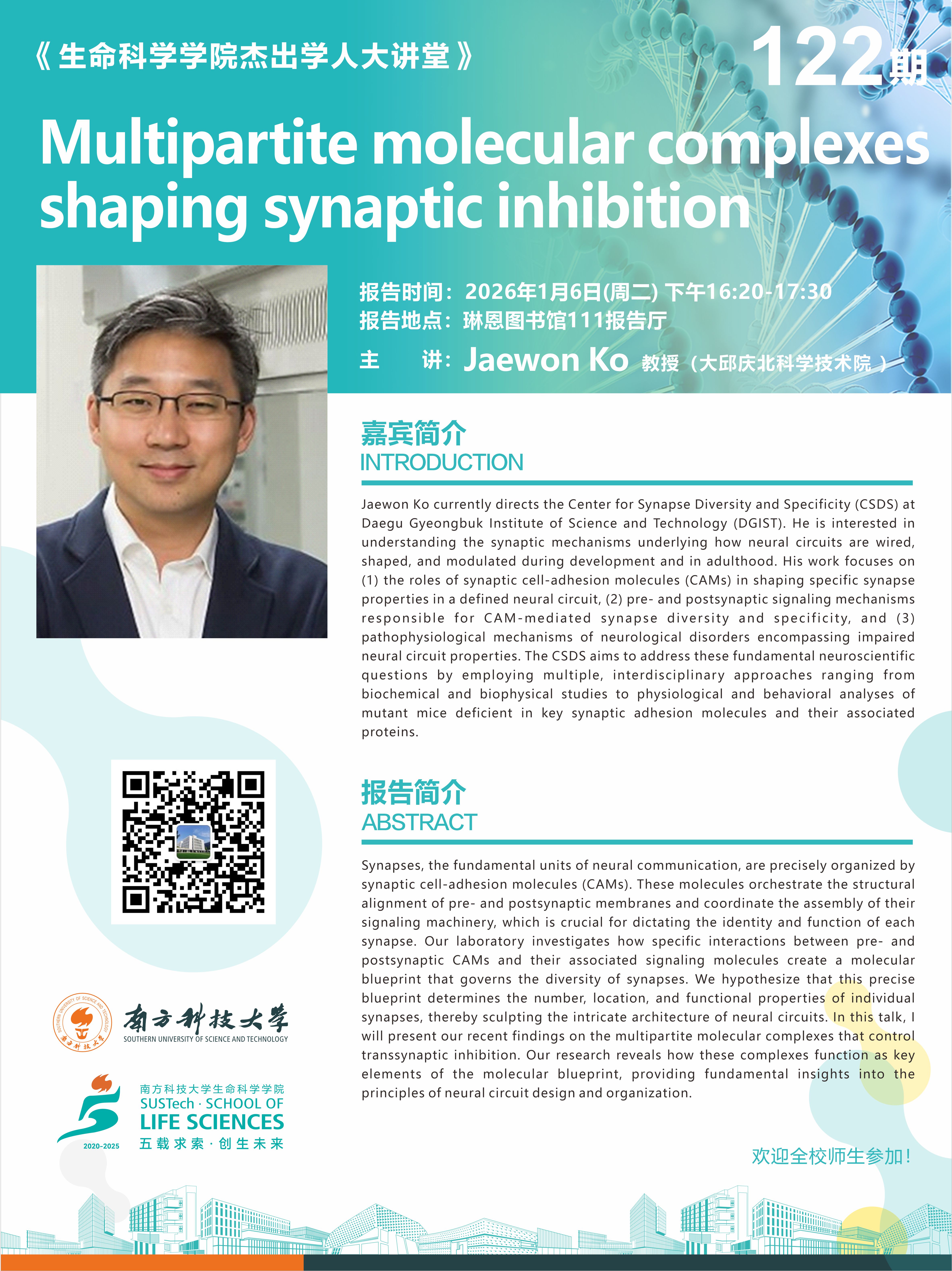
主讲人: Jaewon Ko 教授
时间: 2026年1月6日(周二)16:20-17:30
地点: 琳恩图书馆111报告厅
时 间:2026年1月6日(周二)下午16:20-17:30
地 点:琳恩图书馆111报告厅
主 讲:Jaewon Ko 教授(大邱庆北科学技术院 )
题 目:Multipartite molecular complexes shaping synaptic inhibition
嘉宾简介:
Jaewon Ko currently directs the Center for Synapse Diversity and Specificity (CSDS) at Daegu Gyeongbuk Institute of Science and Technology (DGIST). He is interested in understanding the synaptic mechanisms underlying how neural circuits are wired, shaped, and modulated during development and in adulthood. His work focuses on (1) the roles of synaptic cell-adhesion molecules (CAMs) in shaping specific synapse properties in a defined neural circuit, (2) pre- and postsynaptic signaling mechanisms responsible for CAM-mediated synapse diversity and specificity, and (3) pathophysiological mechanisms of neurological disorders encompassing impaired neural circuit properties. The CSDS aims to address these fundamental neuroscientific questions by employing multiple, interdisciplinary approaches ranging from biochemical and biophysical studies to physiological and behavioral analyses of mutant mice deficient in key synaptic adhesion molecules and their associated proteins.
报告摘要:
Synapses, the fundamental units of neural communication, are precisely organized by synaptic cell-adhesion molecules (CAMs). These molecules orchestrate the structural alignment of pre- and postsynaptic membranes and coordinate the assembly of their signaling machinery, which is crucial for dictating the identity and function of each synapse. Our laboratory investigates how specific interactions between pre- and postsynaptic CAMs and their associated signaling molecules create a molecular blueprint that governs the diversity of synapses. We hypothesize that this precise blueprint determines the number, location, and functional properties of individual synapses, thereby sculpting the intricate architecture of neural circuits. In this talk, I will present our recent findings on the multipartite molecular complexes that control transsynaptic inhibition. Our research reveals how these complexes function as key elements of the molecular blueprint, providing fundamental insights into the principles of neural circuit design and organization.