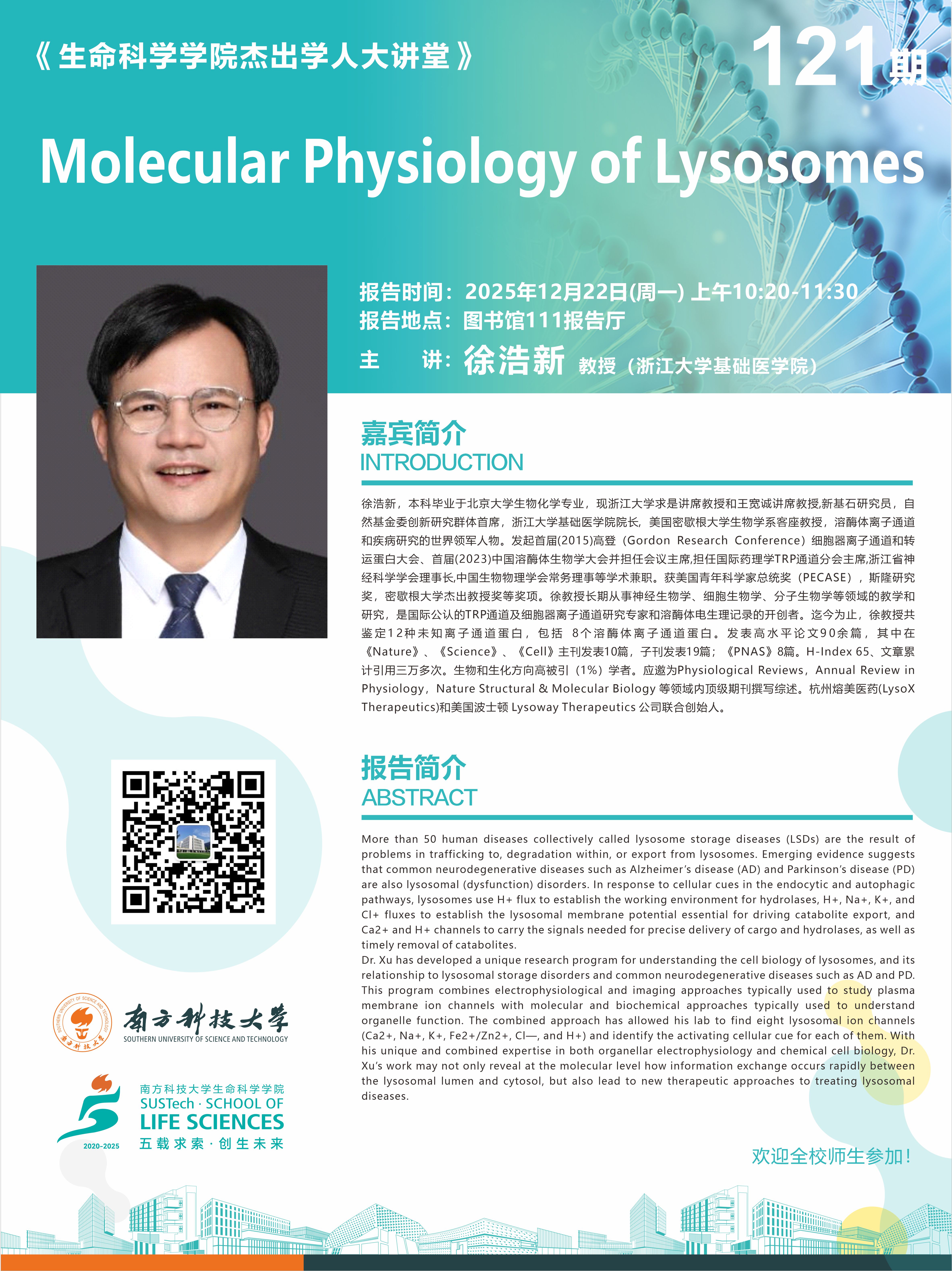
主讲人: 徐浩新 教授
时间: 2025年12月22日(周一)10:20-11:30
地点: 琳恩图书馆111报告厅
题 目:Molecular Physiology of Lysosomes
主 讲:徐浩新 教授
时 间:2025年12月22日(周一)上午10:20-11:30
地 点:琳恩图书馆111报告厅
嘉宾简介:
徐浩新,本科毕业于北京大学生物化学专业,现浙江大学求是讲席教授和王宽诚讲席教授,新基石研究员,自然基金委创新研究群体首席,浙江大学基础医学院院长,美国密歇根大学生物学系客座教授,溶酶体离子通道和疾病研究的世界领军人物。发起首届(2015)高登(Gordon Research Conference)细胞器离子通道和转运蛋白大会、首届(2023)中国溶酶体生物学大会并担任会议主席,担任国际药理学TRP通道分会主席,浙江省神经科学学会理事长,中国生物物理学会常务理事等学术兼职。获美国青年科学家总统奖(PECASE),斯隆研究奖,密歇根大学杰出教授奖等奖项。徐教授长期从事神经生物学、细胞生物学、分子生物学等领域的教学和研究,是国际公认的TRP通道及细胞器离子通道研究专家和溶酶体电生理记录的开创者。迄今为止,徐教授共鉴定12种未知离子通道蛋白,包括 8个溶酶体离子通道蛋白。发表高水平论文90余篇,其中在《Nature》、《Science》、《Cell》主刊发表10篇,子刊发表19篇;《PNAS》8篇。H-Index 65、文章累计引用三万多次。生物和生化方向高被引(1%)学者。应邀为Physiological Reviews,Annual Review in Physiology,Nature Structural & Molecular Biology 等领域内顶级期刊撰写综述。杭州熔美医药(LysoX Therapeutics)和美国波士顿 Lysoway Therapeutics 公司联合创始人。
报告摘要:
More than 50 human diseases collectively called lysosome storage diseases (LSDs) are the result of problems in trafficking to, degradation within, or export from lysosomes. Emerging evidence suggests that common neurodegenerative diseases such as Alzheimer’s disease (AD) and Parkinson’s disease (PD) are also lysosomal (dysfunction) disorders. In response to cellular cues in the endocytic and autophagic pathways, lysosomes use H+ flux to establish the working environment for hydrolases, H+, Na+, K+, and Cl+ fluxes to establish the lysosomal membrane potential essential for driving catabolite export, and Ca2+ and H+ channels to carry the signals needed for precise delivery of cargo and hydrolases, as well as timely removal of catabolites.
Dr. Xu has developed a unique research program for understanding the cell biology of lysosomes, and its relationship to lysosomal storage disorders and common neurodegenerative diseases such as AD and PD. This program combines electrophysiological and imaging approaches typically used to study plasma membrane ion channels with molecular and biochemical approaches typically used to understand organelle function. The combined approach has allowed his lab to find eight lysosomal ion channels (Ca2+, Na+, K+, Fe2+/Zn2+, Cl—, and H+) and identify the activating cellular cue for each of them. With his unique and combined expertise in both organellar electrophysiology and chemical cell biology, Dr. Xu’s work may not only reveal at the molecular level how information exchange occurs rapidly between the lysosomal lumen and cytosol, but also lead to new therapeutic approaches to treating lysosomal diseases.