
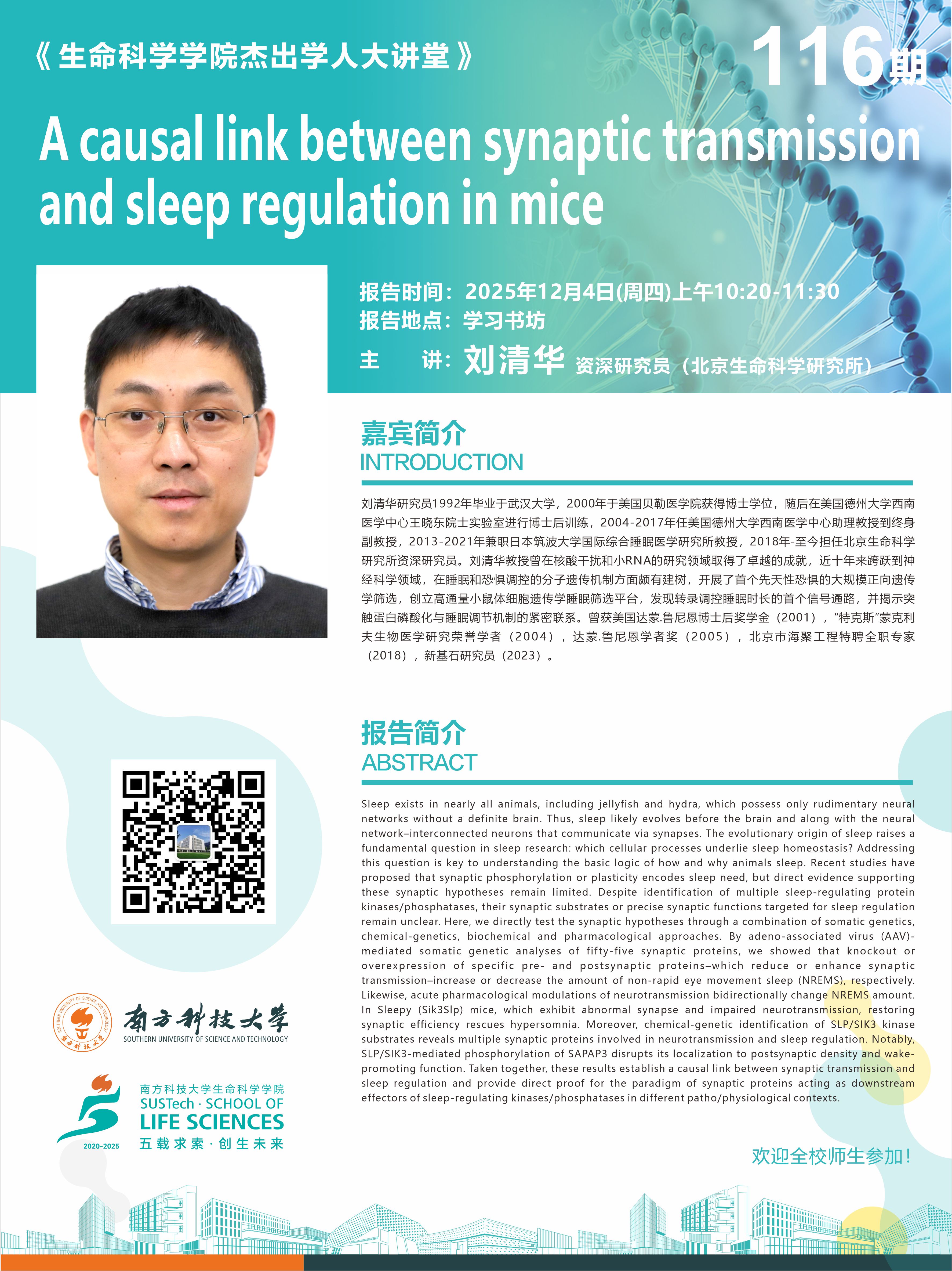
主讲人: 刘清华 资深研究员(北京生命科学研究所)
时间: 2025年12月4日(周四)上午10:20-11:30
地点: 学习书坊
题 目:A causal link between synaptic transmission and sleep regulation in mice
主 讲:刘清华 资深研究员(北京生命科学研究所)
时 间:2025年12月4日(周四)上午10:20-11:30
地 点:学习书坊
摘要:
Sleep exists in nearly all animals, including jellyfish and hydra, which possess only rudimentary neural networks without a definite brain. Thus, sleep likely evolves before the brain and along with the neural network–interconnected neurons that communicate via synapses. The evolutionary origin of sleep raises a fundamental question in sleep research: which cellular processes underlie sleep homeostasis? Addressing this question is key to understanding the basic logic of how and why animals sleep. Recent studies have proposed that synaptic phosphorylation or plasticity encodes sleep need, but direct evidence supporting these synaptic hypotheses remain limited. Despite identification of multiple sleep-regulating protein kinases/phosphatases, their synaptic substrates or precise synaptic functions targeted for sleep regulation remain unclear. Here, we directly test the synaptic hypotheses through a combination of somatic genetics, chemical-genetics, biochemical and pharmacological approaches. By adeno-associated virus (AAV)-mediated somatic genetic analyses of fifty-five synaptic proteins, we showed that knockout or overexpression of specific pre- and postsynaptic proteins–which reduce or enhance synaptic transmission–increase or decrease the amount of non-rapid eye movement sleep (NREMS), respectively. Likewise, acute pharmacological modulations of neurotransmission bidirectionally change NREMS amount. In Sleepy (Sik3Slp) mice, which exhibit abnormal synapse and impaired neurotransmission, restoring synaptic efficiency rescues hypersomnia. Moreover, chemical-genetic identification of SLP/SIK3 kinase substrates reveals multiple synaptic proteins involved in neurotransmission and sleep regulation. Notably, SLP/SIK3-mediated phosphorylation of SAPAP3 disrupts its localization to postsynaptic density and wake-promoting function. Taken together, these results establish a causal link between synaptic transmission and sleep regulation and provide direct proof for the paradigm of synaptic proteins acting as downstream effectors of sleep-regulating kinases/phosphatases in different patho/physiological contexts.
个人简介:
刘清华研究员1992年毕业于武汉大学,2000年于美国贝勒医学院获得博士学位,随后在美国德州大学西南医学中心王晓东院士实验室进行博士后训练,2004-2017年任美国德州大学西南医学中心助理教授到终身副教授,2013-2021年兼职日本筑波大学国际综合睡眠医学研究所教授,2018年-至今担任北京生命科学研究所资深研究员。刘清华教授曾在核酸干扰和小RNA的研究领域取得了卓越的成就,近十年来跨跃到神经科学领域,在睡眠和恐惧调控的分子遗传机制方面颇有建树,开展了首个先天性恐惧的大规模正向遗传学筛选,创立高通量小鼠体细胞遗传学睡眠筛选平台,发现转录调控睡眠时长的首个信号通路,并揭示突触蛋白磷酸化与睡眠调节机制的紧密联系。曾获美国达蒙.鲁尼恩博士后奖学金(2001),“特克斯”蒙克利夫生物医学研究荣誉学者(2004),达蒙.鲁尼恩学者奖(2005),北京市海聚工程特聘全职专家(2018),新基石研究员(2023)。